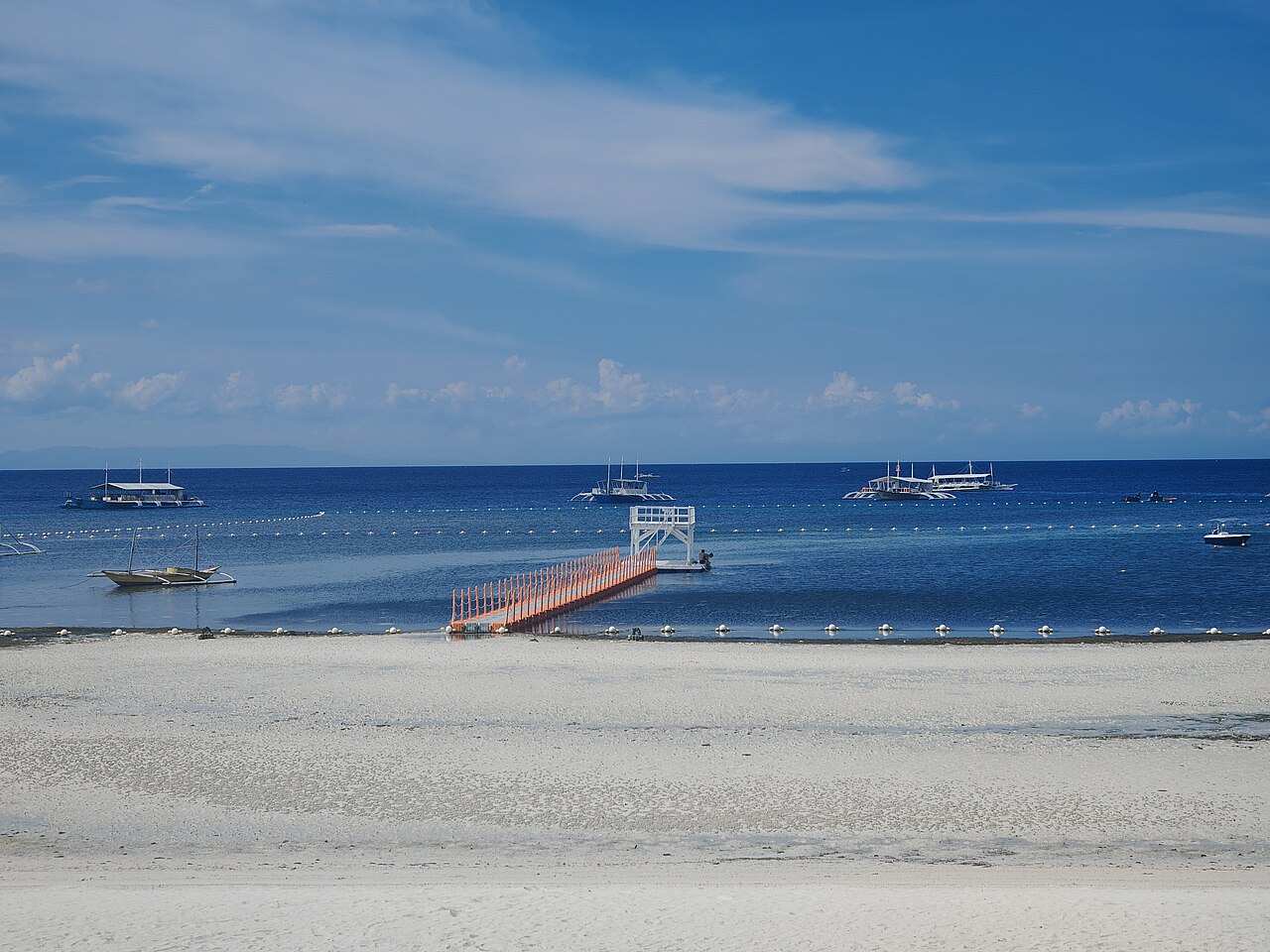
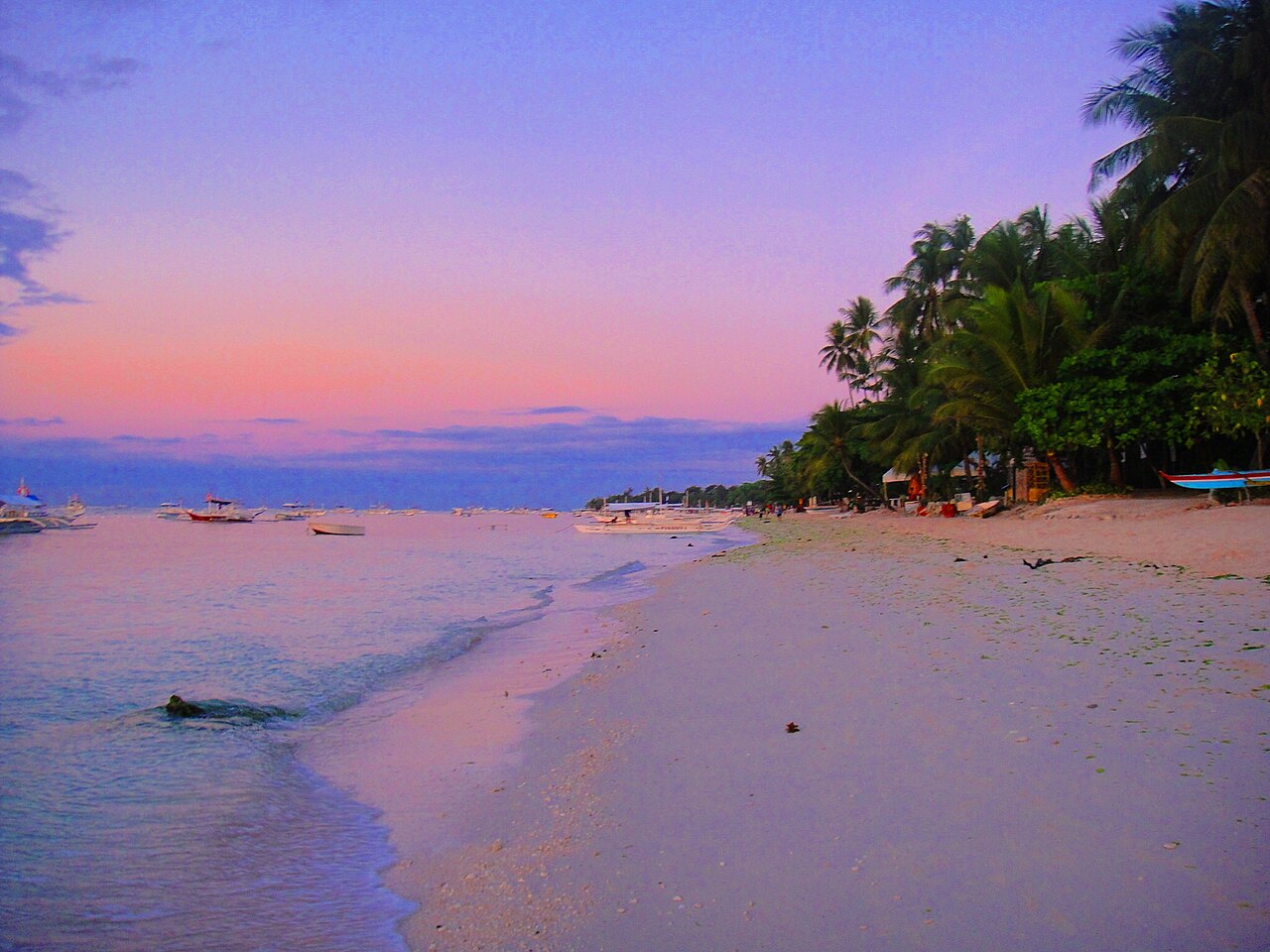
Doljo Beach sits on the north-west tip of Panglao Island in Bohol and has become the closest thing Asia has to a depth-training capital. A fixed line in roughly 50 m of water lies about a 15 m swim from shore, permanent 80 m and 130 m buoys hang in the same bay, and a platform beyond the reef sits over water more than 300 m deep — so a first 20 m dive and a national-record attempt happen in the same patch of sea. There is effectively no thermocline, current and swell are usually light, water runs 26–30 °C year round, and visibility is typically 15–30 m, opening to 30–40 m from March to May. The 10th AIDA Asian Freediving Cup ran here 13–23 July 2026, with competition lines set to a maximum of 145 m.
A fixed 50 m line reachable by a short surface swim — shore-based depth training without a boat is rare anywhere, and 80 m and 130 m buoys stay rigged in the same bay
The Freedive SuperHOME platform out past the reef over 300 m-plus water: six lines since 2024, two of them served by a counterballast system, and the base for 100 m sessions
Permanent home of the AIDA Asian Freediving Cup; the 2026 edition ran 13–23 July with CWT, FIM and CNF contested on a rope set to 145 m
Napaling Reef on the same coast — a wall that drops away just under the surface, known for its sardine ball and the usual fun-dive counterweight to line work
AIDA, Molchanovs and SSI schools clustered along one beach, with pathways running all the way to instructor level
Flat, warm, largely current-free water with no thermocline, which makes it a forgiving place to rebuild equalisation and freefall
Good to know
SafetyFreediving deaths are driven by hypoxic shallow water blackout and LMC, and most happen in the last 10 m of the ascent or in the seconds after surfacing. Never dive alone at any depth, use strict one-up-one-down with a buddy meeting you on the final stretch, and wear a lanyard on the line. Deep sessions here require paid safety freedivers (one or two depending on the depth band) — confirm how many are assigned to you when you book. Bangka boats work the water off Doljo, so stay tied to the buoy and dive flag rather than surfacing wherever you like, and make yourself unmistakably visible if you drift outside the line area.
SafetyDay after day of deep diving gives freedivers decompression sickness and lung squeeze too. Keep daily deep-dive counts, ascent rates and surface intervals conservative, and stop immediately and seek medical help if you cough blood-streaked sputum or feel chest pain or breathlessness. Do not hyperventilate — it only raises blackout risk. Avoid deep apnea on a day you have been scuba diving, and avoid flying soon after diving.
SafetyThe chamber on Panglao was reported non-operational as of 2025, so a serious hit means evacuation to Cebu (Mandaue), roughly 1.5 hours away by boat. Carry travel or diver insurance that names freediving — and, where relevant, competition and deep training — explicitly, and ask your centre directly about current chamber status and the evacuation plan before you arrive.
RulesAccess to the deep lines is gated. SuperHOME sets Molchanovs Wave 3 / AIDA 4 as the bar for autonomous training and requires coaching below that. Competition entry needs a minimum age of 18 (16 with parental consent), a physician-signed medical statement no older than one year, and membership of the AIDA National matching your passport; announced depths are capped at your personal best in that discipline plus 5 m over the last three months. The rope zone is closed to the public during the competition, so if your trip overlaps, get your training line and time slot allocated in advance. These conditions are revised each year, so read the current official page.
SeasonJune to October is the habagat (south-west monsoon), when a rough surface can cancel line setups and boat departures, and typhoon activity peaks September to November. Bohol sits in the central Visayas and is more sheltered than the eastern seaboard, but cancellations still happen. Water is clearest March to May, and November to April (amihan) is generally the calmest stretch.
MannersDoljo is a working local beach and the reefs around it belong to the Bohol Marine Triangle. Do not stand on or touch coral, and at nearby sites such as Napaling the local norm is to not chase or swim through the sardine ball. Use reef-conscious sunscreen, and expect small beach access or environmental fees to be collected in cash — ask for a receipt.
CautionBe wary of informal 'guides' or gear rental offered on the sand, and of packages that only take cash up front. Instructor credentials and their expiry can be checked on the official AIDA, Molchanovs and SSI verification systems, and it is worth getting line fees and whether a safety diver is included confirmed in writing before you pay.
Practical info
Bohol-Panglao International Airport (TAG) is a 15–20 minute drive from Doljo Beach, reached via Manila or Cebu, and direct services from Seoul Incheon have operated in some seasons — routes change, so check before booking. March to June is the best training window; deep lines, safety divers and accommodation packages fill fast around the July competition season, so book ahead. Prices, opening hours, certification prerequisites and chamber availability all change, so verify the latest details directly with the centres and the competition's official page.
On-site reviews📍 Verified on-site
No reviews yet. If you are here, be the first to leave one.