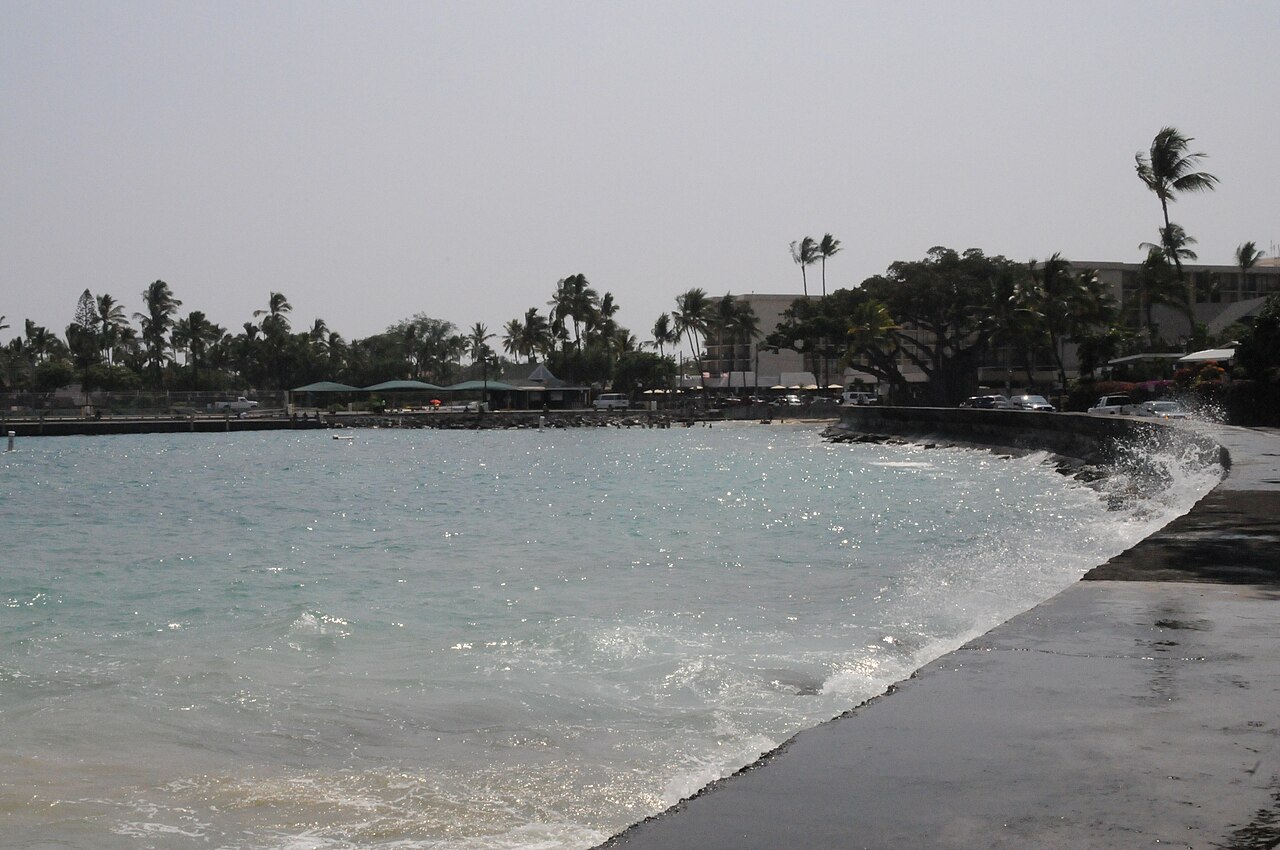
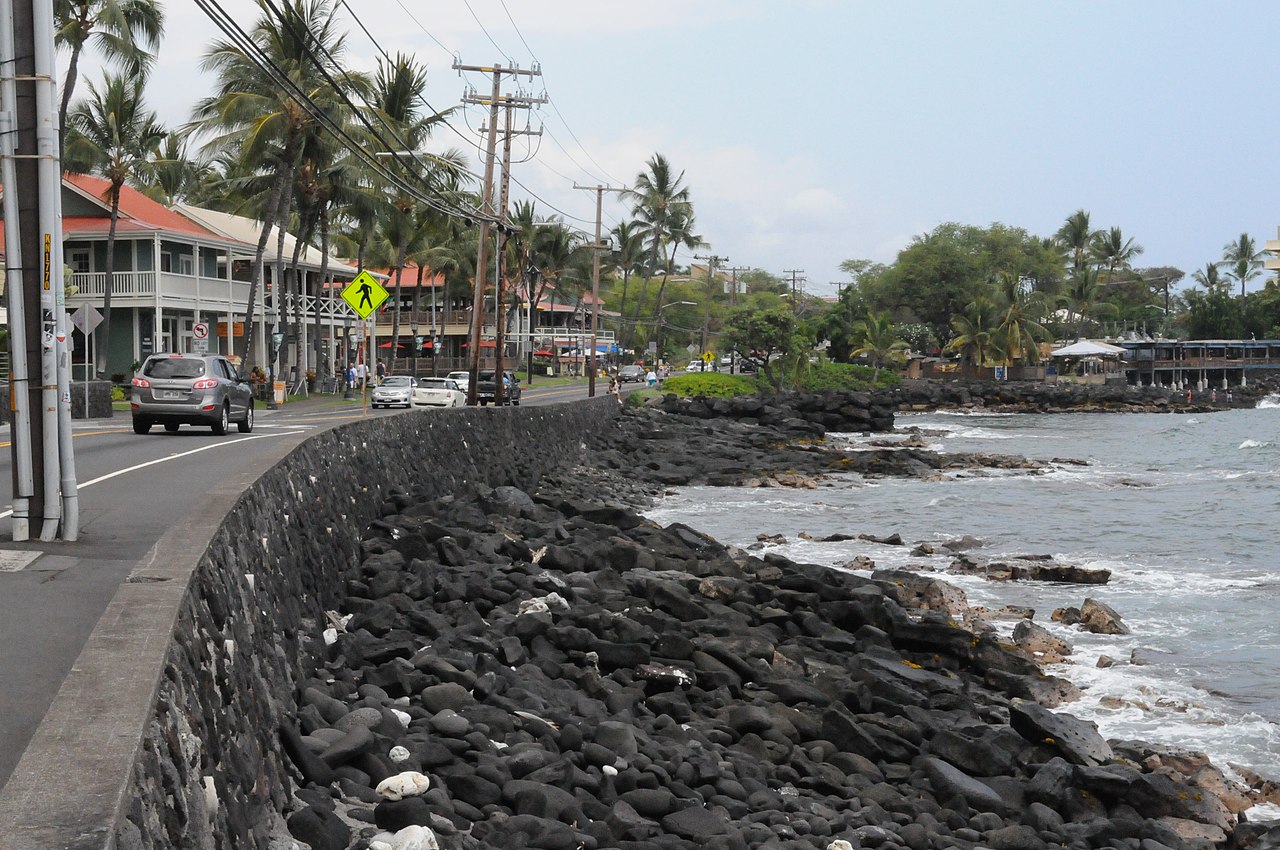
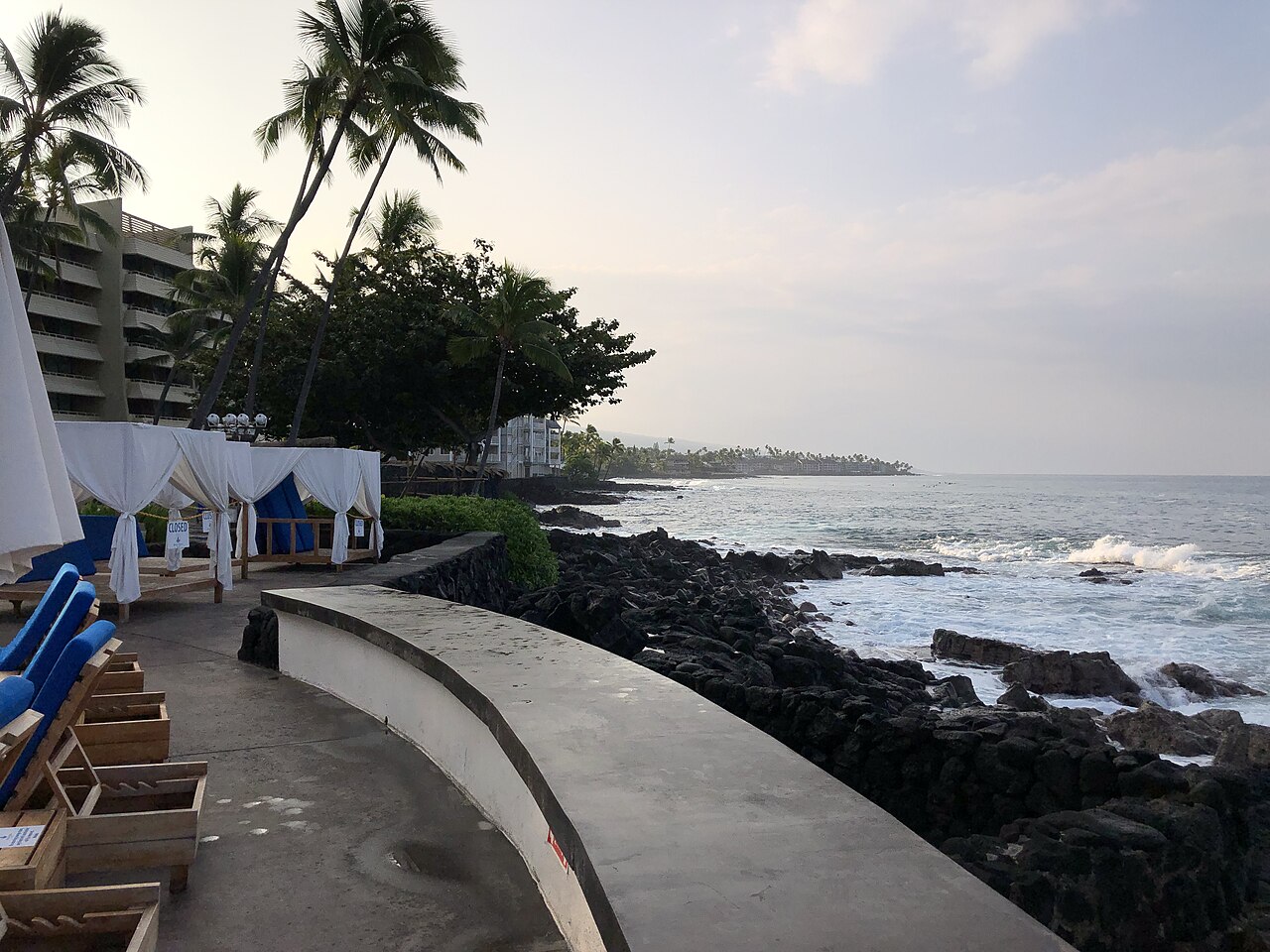
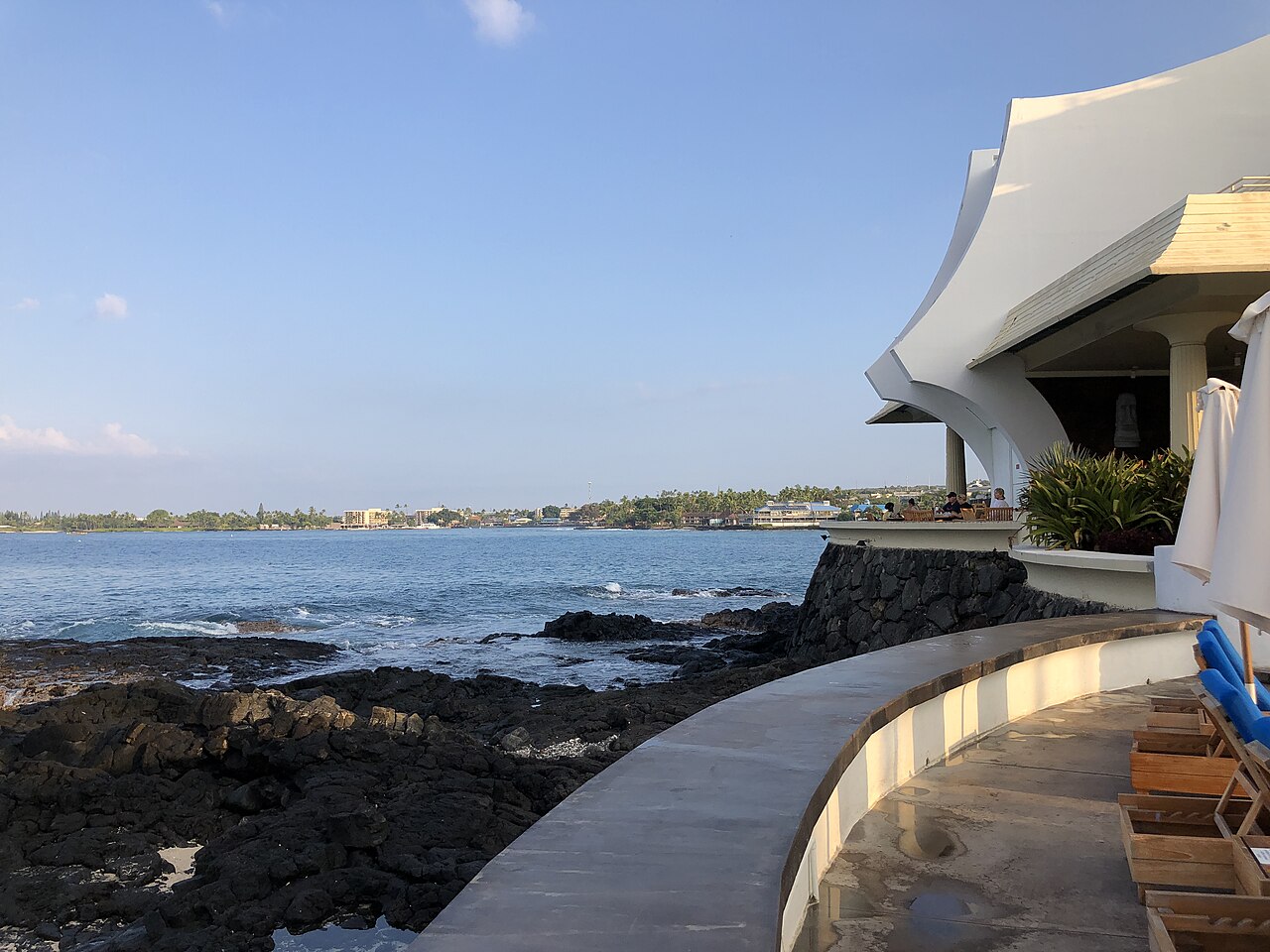
On Kona, the steep western flank of Mauna Loa simply keeps going underwater: you hit 30m not far off the beach, and a short boat ride puts hundreds of metres beneath you. Because this is the leeward side, the island blocks the trade winds, making it one of the calmest, clearest stretches of the Pacific, with water at 24~27°C year-round and visibility routinely past 30m (up to 40m in Kealakekua Bay) — the conditions that make real depth training possible. FII-affiliated schools run here continuously, from Level 1 (20m) through Level 2 (the 20~40m range), and manta night sessions and blackwater dives round out the offering. That said, as of 2026 freediving and spearfishing rank second among fatal ocean drownings for Hawai'i residents, and a warning-label bill (HB 1765) is before the state legislature — safety is the live local conversation here, not a footnote.
The Kona-Kohala slope — 30m close to shore dropping past 300m a few miles out, so a 10~20 minute boat run gets you a deep line with no bottom in sight
Kealakekua Bay — a Marine Life Conservation District and state historical park, with 40m visibility over a steep wall and resident spinner dolphins (which are regulated, see below)
Two Step (Honaunau Bay) — lava that hardened into natural steps makes for an easy shallow-reef entry, ideal for morning warm-ups before the wind fills in
Manta night sessions and blackwater diving — mantas feeding in shallow water, and larval deep-sea creatures rising offshore after dark; blackwater is for experienced divers on dedicated boats only
Humpback season (mid-November to mid-May) — close enough that you hear whale song underwater, though this is also when approach rules and vessel restrictions bite hardest
Good to know
SafetyShallow water blackout and LMC are what actually kill people here. At least 58 people died freediving in Hawai'i between 2014 and 2025, making freediving and spearfishing the second leading activity in resident ocean drownings. A blackout is silent — no thrashing, no splash. Dive one up, one down with a trained buddy, keep hands-on surface supervision for at least 30 seconds after every ascent, and never dive alone, not even on a shallow reef.
SafetyBlue-water depth work requires a proper dive line, a lanyard, counterballast, and a dedicated safety diver. With no visual reference offshore you cannot judge depth by feel, and 30~40m visibility creates an illusion of shallowness that pushes divers past their limits. Save personal bests for supervised sessions with a coach and safety team, and add depth in small increments across days, not within one session.
SafetyLung squeeze, arterial gas embolism, and taravana from repetitive diving all happen to freedivers. Hawai'i's only 24/7 emergency recompression chamber is on O'ahu (the UH JABSOM Hyperbaric Treatment Center), so an incident on the Big Island means an air evacuation and lost time. US medical costs are severe — carry travel insurance with dive coverage that explicitly names freediving (DAN or equivalent).
SafetyOffshore currents and downcurrents are a genuine hazard, and boat traffic around Kailua Pier and the Honokohau Harbour mouth makes floating without a surface buoy and dive flag dangerous. Encounters with large sharks, including tigers, do occur. Blackwater and night sessions should only be done from a professional operator's boat.
RulesFederal law prohibits swimming with, approaching, or remaining within 50 yards (about 46m) of a Hawaiian spinner dolphin (in effect since October 2021). Humpback whales require 100 yards (about 91m) in or on the water and 1,000 feet (about 300m) for drones and aircraft. Animals approaching you is fine; pursuing them or placing yourself in their path is not, and penalties are steep.
RulesKealakekua Bay is both a state historical park and a Marine Life Conservation District. Commercial activity and kayak operations require permits and decals, launching from Napo'opo'o wharf is prohibited, and landing at Ka'awaloa Flat is not allowed. If you rent a kayak or book a tour, confirm the operator holds a valid permit, and check the state parks division for current rules — they do change.
SeasonMay to September brings the calmest seas and the best visibility. Winter northwest swells and Kona lows roughen things up and cause boat cancellations, and wind builds most afternoons year-round, so book sessions for the morning.
Practical info
Kona International Airport (KOA) takes direct JAL service from Tokyo and connections through Honolulu (a 40~50 minute interisland hop) from most other origins; US entry needs ESTA or a visa, and a rental car is effectively mandatory on the Big Island. Book courses and boat line sessions several weeks out — operators often require a health questionnaire and proof of certification — and confirm current pricing, sailing schedules, and permit conditions directly with the operator and the relevant state and federal agencies before you commit.
On-site reviews📍 Verified on-site
No reviews yet. If you are here, be the first to leave one.