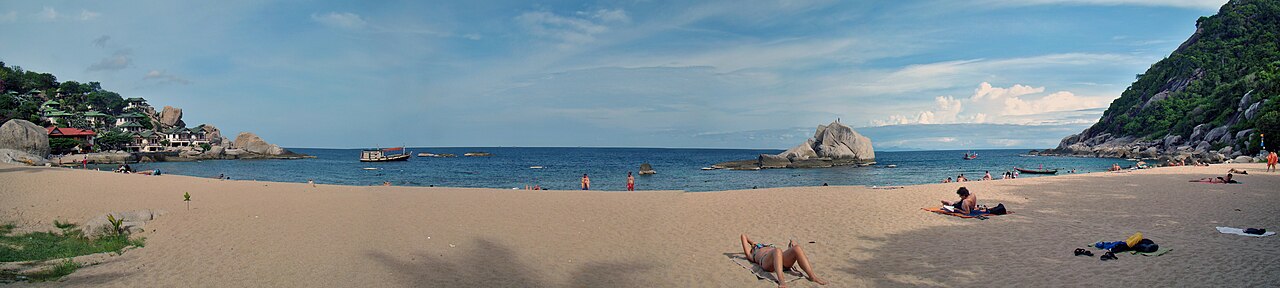
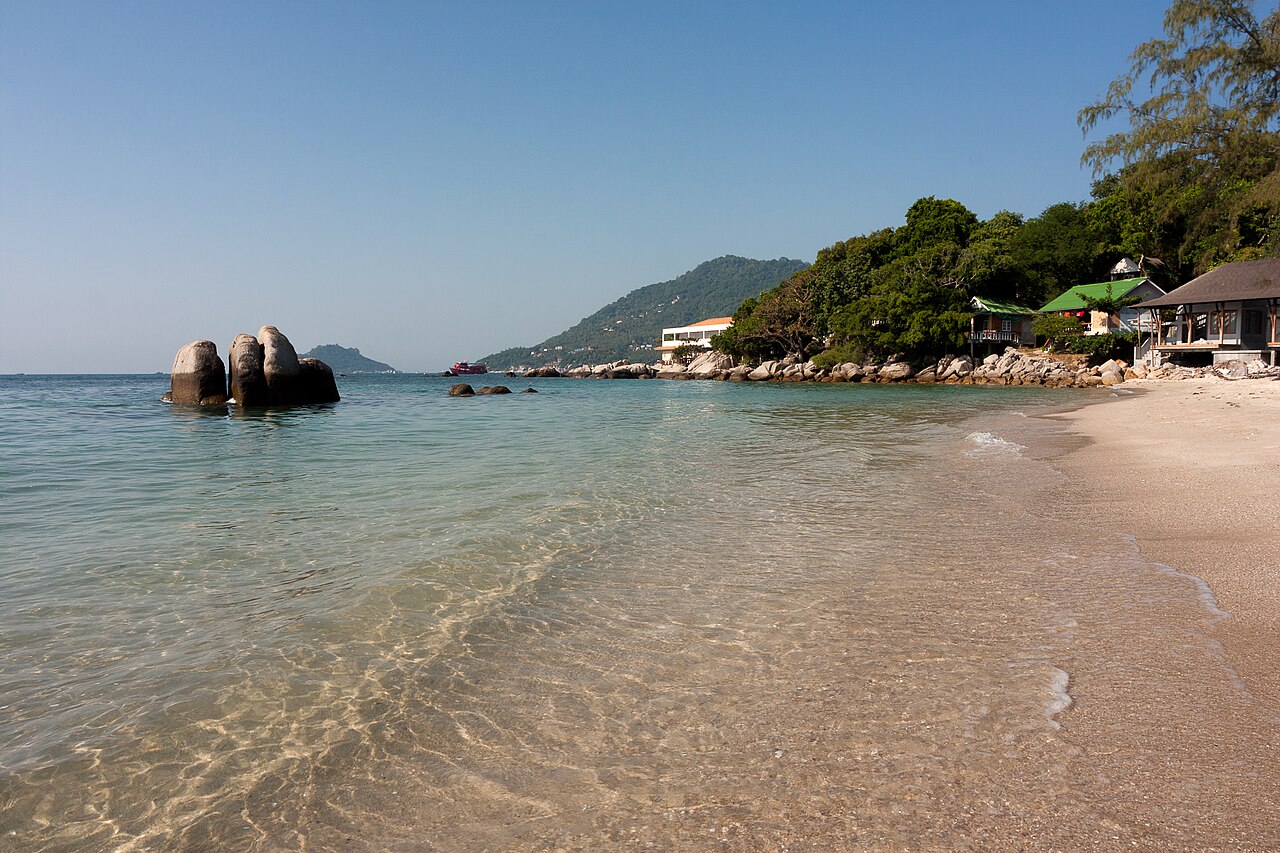
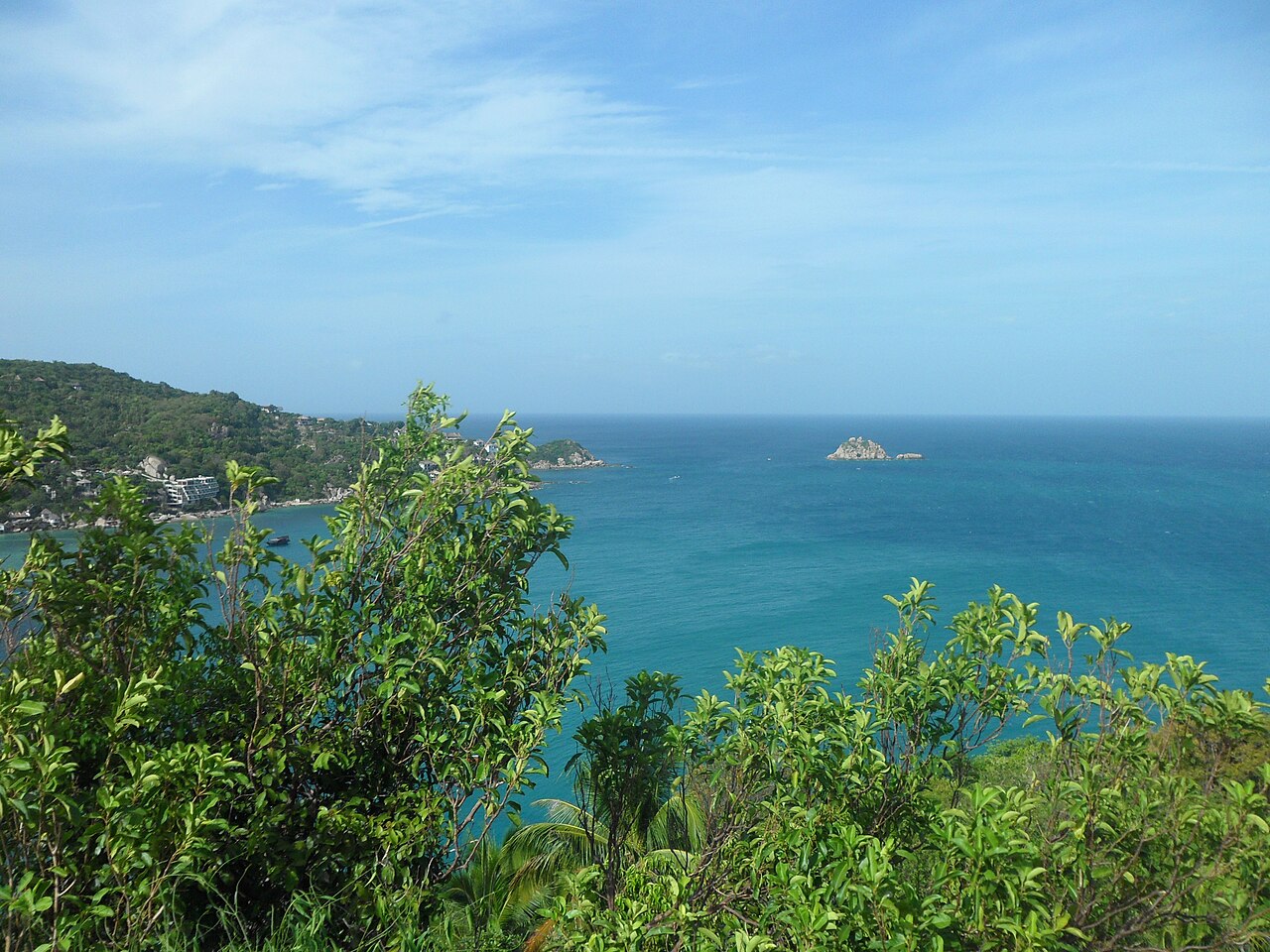
Koh Tao is a small island in Thailand's Surat Thani province, and Sairee Beach on its west coast is where most of the world's freedivers take their first breath-hold course. Apnea Total opened here in 2004 and still runs its education-system headquarters off Sairee, having certified more than 6,000 students at this one site; today AIDA, SSI, PADI, RAID and Molchanovs schools all operate along the same stretch of sand. Water sits at 27-30°C year-round, so long sessions in a thin suit are comfortable, and visibility runs roughly 15-25m on good days, dropping to 5-10m in the monsoon. As of 2026 the teaching infrastructure is arguably the densest anywhere — which also means crowded buoys and safety divers watching more people than they should.
The permanent training buoys just off Sairee — a sheltered bay where beginners can repeat CWT and FIM descents on a single line without fighting swell
A clear depth ladder: 10-20m on entry courses, 30m on advanced lines, with some schools running dedicated 40m sessions when conditions allow
Mango Bay (sandy bottom, 1-16m) and Buoyancy World — shallow, calm backup sites used for equalisation troubleshooting and static/dynamic work
Shark Island and the Hin Wong slopes: boulder terrain and reef walls where blacktip reef sharks and barracuda show up seasonally, right beside the line
The rare chance to compare AIDA, SSI, PADI, RAID and Molchanovs within walking distance, with instructor-level training running continuously
Good to know
SafetyShallow water blackout — not depth — kills more freedivers than anything else. The last 10m of the ascent and the first 30 seconds on the surface are the danger zone, and it arrives with no warning while you still feel strong. Never train breath-hold alone under any circumstances, dive only with a buddy watching from the surface, and hold the standard recovery protocol: eye contact and an 'I'm OK' signal maintained for at least 30 seconds after surfacing.
SafetyHyperventilating before a dive suppresses the CO2 urge to breathe and brings blackout on sooner — don't do it. On deep sessions wear a lanyard, and on day one physically confirm that the buoy, down-line and counterballast are actually rigged. Koh Tao's student volume means several teams often share one buoy; if a single safety diver is covering multiple divers at once, you are entitled to sit that session out. Schools running small groups are the safer choice here.
SafetyThe water off Sairee carries heavy dive-boat, speedboat, longtail and jet-ski traffic, and a surfacing freediver is nearly invisible from a boat — never enter without a high-visibility buoy and dive flag. Separately, Koh Tao's arches and swim-throughs were mapped for scuba. Entering any overhead environment on a breath-hold means a blackout cannot float you to the surface: treat them as off-limits while freediving. Know what happens if it goes wrong, too: medical facilities on the island are small, and while the SSS recompression chamber runs 24/7 it treats decompression illness — blackout and near-drowning mean oxygen on scene followed by evacuation to Koh Samui or Surat Thani, which takes hours.
RulesStandard guidance is to leave at least 24 hours between scuba diving and freediving, since residual nitrogen plus repeated pressure cycles raises decompression risk. Beyond that, most schools require certification or course enrolment to join line sessions and will ask for a medical questionnaire and liability waiver; declare any ear, sinus, cardiovascular or seizure history up front. Insurance matters more than people expect — ordinary travel policies frequently exclude freediving as a hazardous activity, so check the wording before you fly and consider DAN or another policy that names breath-hold diving and depth explicitly. Course fees, schedules and maximum-depth policies vary by school and change often, so confirm current details when booking.
SeasonThe northeast monsoon in November and December brings bigger swell, run-off that can cut visibility to 5-10m, and frequent ferry delays or cancellations. Conditions are generally best around March-May and August-October, with January-April also fairly settled. If you travel in monsoon season, build a spare day around your flight home in case the boats stop running.
CautionScooter and jet-ski rental disputes are a recurring problem on Koh Tao: operators claim pre-existing scratches on return and demand tens of thousands of baht. Film the whole vehicle before you take it, and never leave your passport as a deposit. Call the Tourist Police on 1155 if it escalates. There is no Grab on the island and taxi fares run high, so agree the price before getting in.
MannersFin strikes on coral are common when people train in the shallow bays. Don't touch coral or marine life, stay vertical over reef, and use reef-safe sunscreen — this is baseline etiquette in the local dive community.
Practical info
There are no flights to Koh Tao itself: route via Bangkok or Koh Samui to Chumphon (roughly 80km by high-speed catamaran) or Surat Thani (overnight ferry, about 9 hours), and budget 12 hours or more door to door. Aim for the clearer March-May or August-October windows, and check course fees, depth policies and ferry timetables directly with the school and the operator shortly before departure, as these change frequently.
On-site reviews📍 Verified on-site
No reviews yet. If you are here, be the first to leave one.