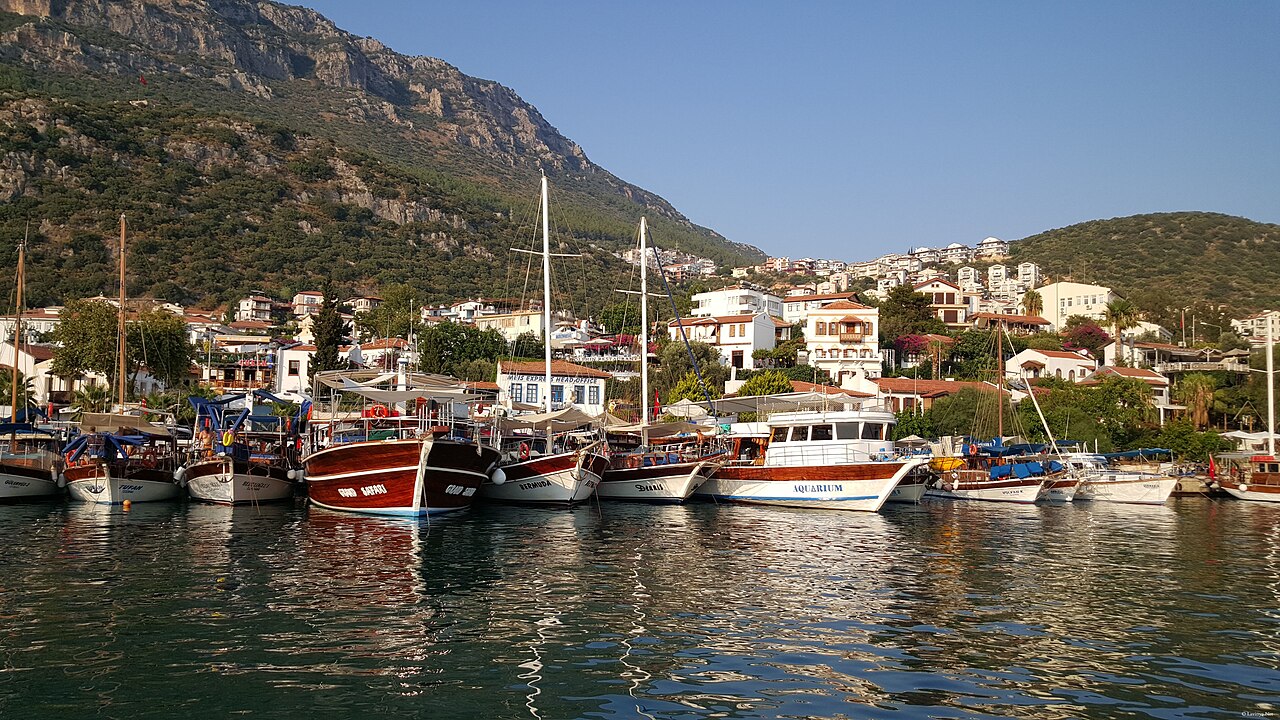
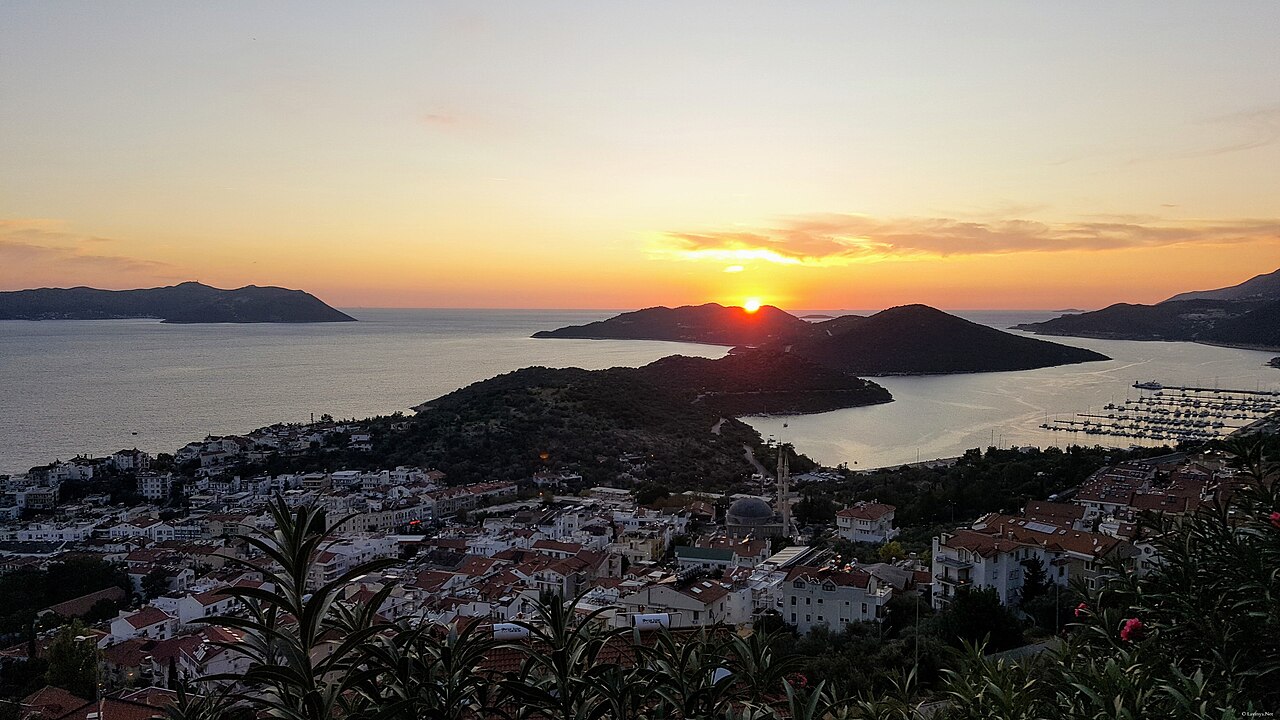
Kas is a small Mediterranean town in Turkey's Antalya province where the seabed drops to 60m barely five minutes' swim from shore, which is exactly why European freedivers keep coming back to train here. There is next to no swell or current, visibility holds at roughly 25-40m, and permanent anchor lines at 15m, 30m and 60m let you repeat depth progressions without hunting for a site. Swim a little further out and depths past 100m open up, which is how Kas ended up hosting CMAS world championship depth events. As of 2026 several freediving schools still run a roughly April-to-October season, and buoy space in midsummer goes fast enough that booking ahead is effectively mandatory.
Three permanent anchor lines at 15m, 30m and 60m, all within a five-minute surface swim - the reason athletes can stack two sessions a day here without boat logistics
The competition-depth ground off the peninsula near the municipal beach (Halk Plaji): about a 300m swim out, deep enough to hang a line to around 100m
August to October, when the thermocline effectively disappears and the water column stays even from surface to depth - the best window for deep sessions
Ancient amphora fields and wreck debris scattered across the bay, worth a look between line sets but strictly hands-off
A compact harbour town where schools, gear shops and guesthouses are all within walking distance, so no car is needed
Good to know
SafetyNever dive the line without a buddy or a dedicated safety diver. Shallow water blackout and LMC cluster in the last 10m before the surface, and an unconscious freediver makes no noise at all - if nobody is watching, nobody knows. Kas is unusual in that the lines are permanently rigged and easy to slip onto alone, and that convenience is precisely what has killed freedivers elsewhere.
SafetyA lanyard is not optional, and anything past 30m belongs on a school buoy with counterballast rigged and a rescue plan briefed. The 60m line sits far below the depth a safety diver can meet you at, so without the gear and trained hands to haul someone up, a problem down there has no solution.
SafetyWork out your evacuation timeline before you get in the water. The nearest hyperbaric and diving-medicine capability is roughly a three-hour drive toward Antalya, so on-site oxygen and airway management are realistically your entire first response. Confirm your buoy carries an O2 kit and that your travel insurance actually covers freediving.
SafetySummer brings heavy dive-boat and yacht traffic through the bay. Fly a buoy and a diver-down flag, and make scanning the surface part of your recovery routine - a freediver floating flat on the surface is very hard to see from a helm.
SeasonFrom March to July a thermocline sits around 15m and the temperature drop through it is abrupt, which is a common trigger for failed equalisation and cramping; size your wetsuit for the colder layer, not the surface. December to February the water falls to roughly 16-18C with markedly worse visibility, and most schools are not running a normal season.
RulesUnderwater cultural heritage in Turkish waters is legally protected. Touching or recovering amphorae and artefacts is prohibited, lift bags are illegal without authorisation, and designated protected sites are open only to permitted scientific work. Pocketing a souvenir here is a criminal matter, not a fine.
RulesForeign divers in Turkey are generally expected to dive through a certified local centre or guide. Schools typically require a completed open-water freediving certification before you can join a line session and cap the buoy at around four people. Rather than looking for somewhere that will wave you through, book in properly - the supervision is the point.
Practical info
Fly into Istanbul, connect to Antalya (AYT) or Dalaman (DLM), then allow around three hours by road to Kas via rental car, airport shuttle or dolmus. The season runs roughly April to October with June, July and September the most reliable; line sessions usually require a certification card and advance booking, so check current pricing, operating dates, prerequisites and insurance requirements directly with the school before you travel.
On-site reviews📍 Verified on-site
No reviews yet. If you are here, be the first to leave one.