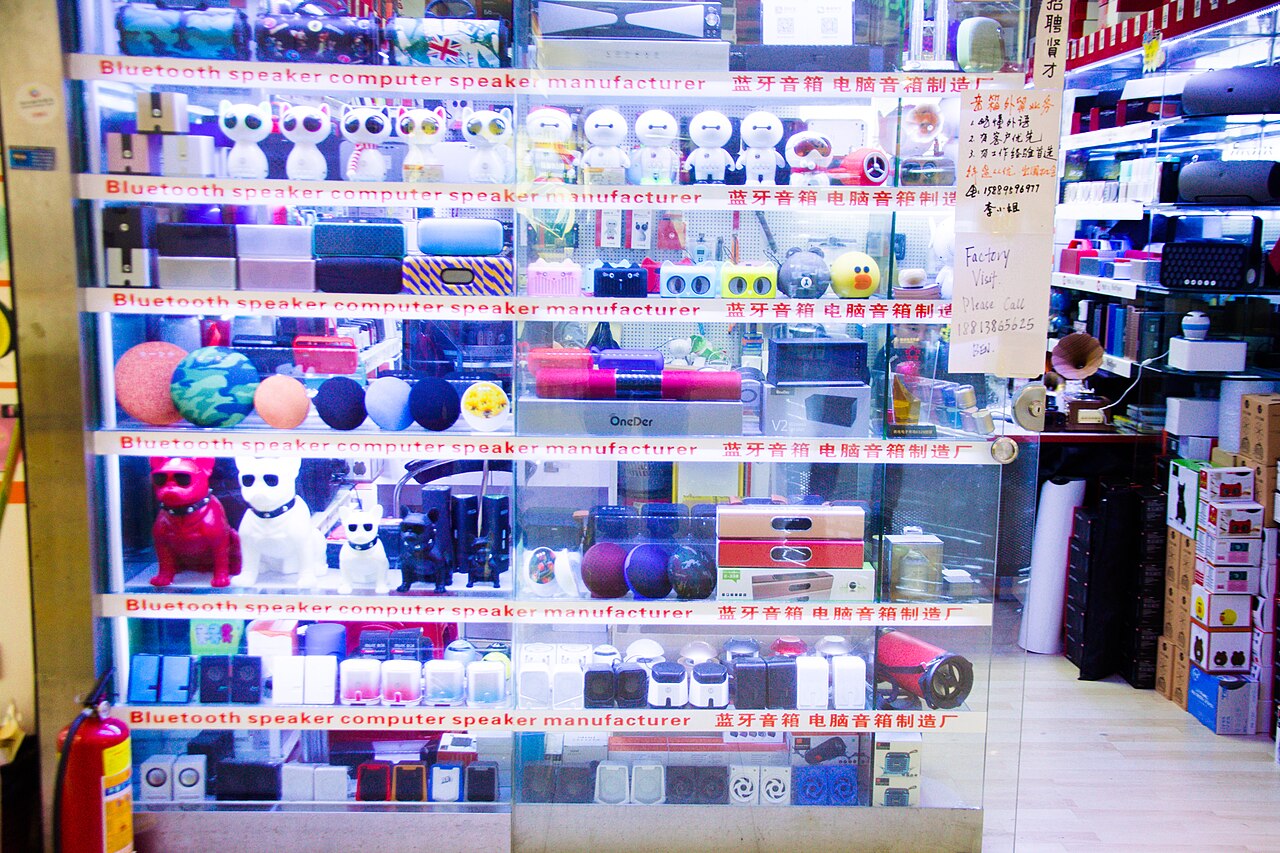
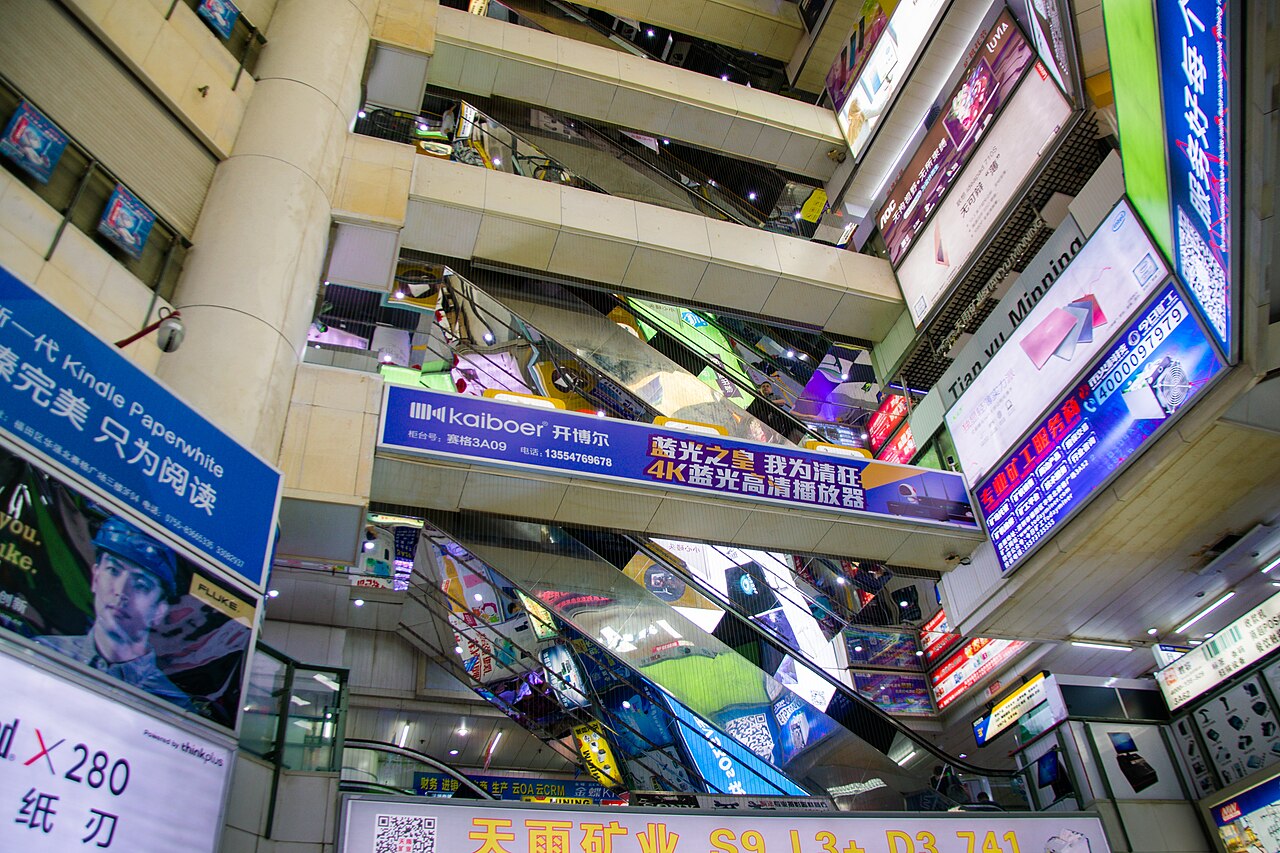
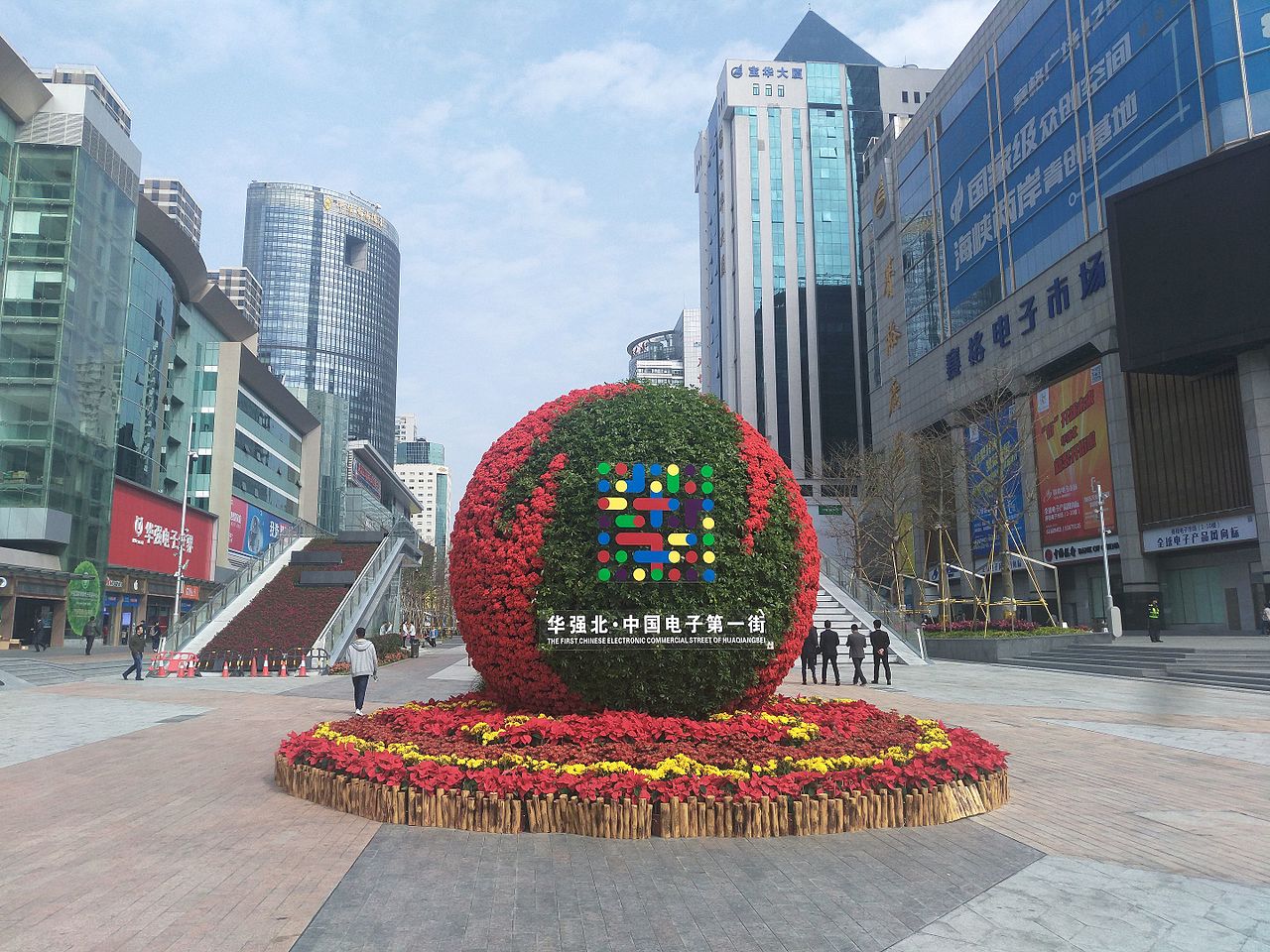
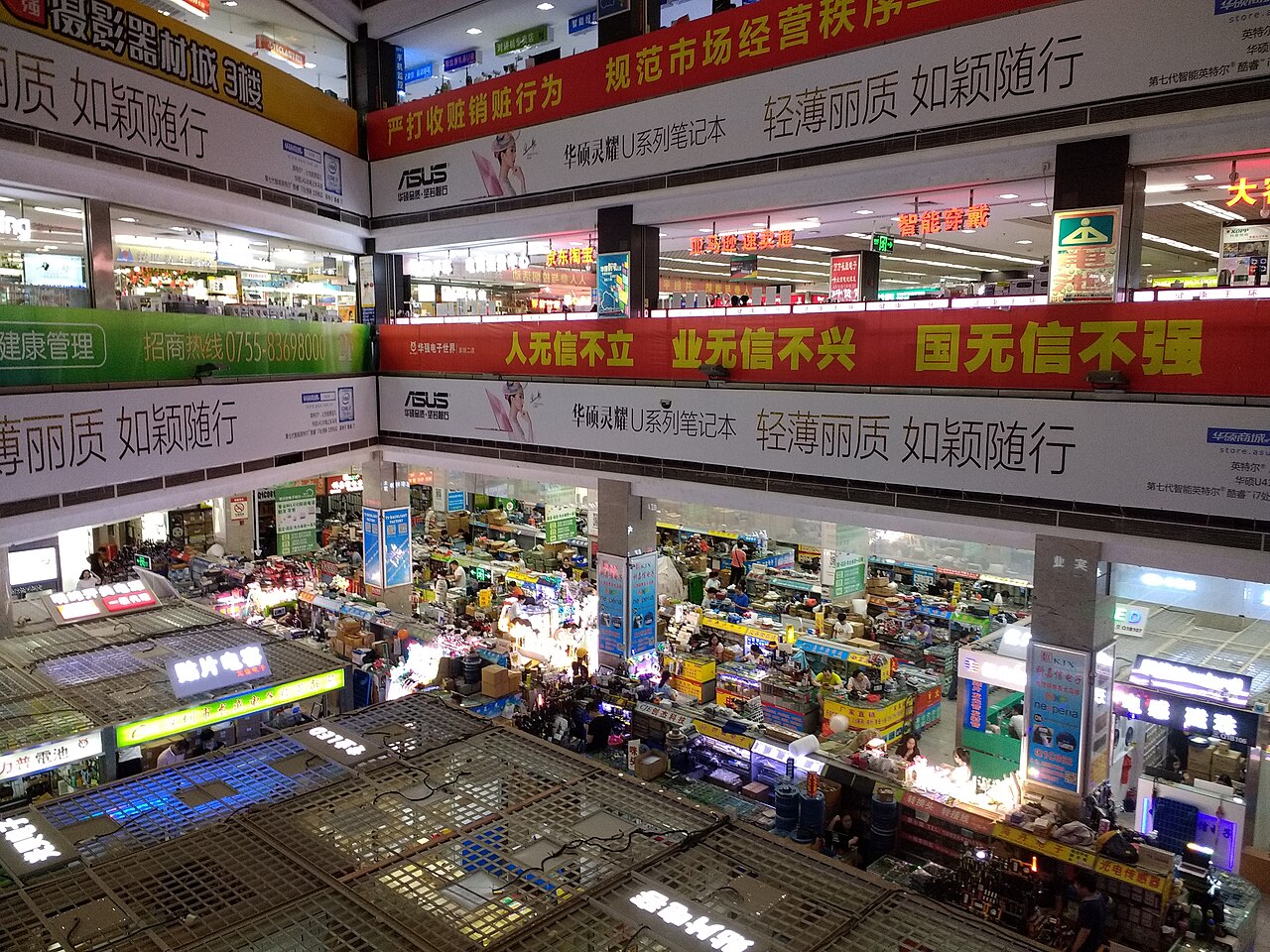
Huaqiangbei, in Shenzhen's Futian District, is known as "China's No.1 Electronics Street" — a dense cluster of multi-storey wholesale malls where you can buy anything from individual resistors to finished drones and robots. It grew out of the SEG electronic components market founded in 1988, and the commercial area now spans roughly 1.45 km²; in January 2017 Huaqiangbei Road reopened as an approximately 930-metre pedestrian street, overlaying a tourist promenade onto what is still a working wholesale district. As of 2026 the mix has shifted away from pure component wholesale toward finished goods — drones, robots, AI toys and smart devices — with a visibly large flow of foreign buyers and travellers. Treat it less as a bargain-hunting destination and more as a place to see China's electronics supply chain up close, and buy cautiously.
The Huaqiangbei Road pedestrian street (about 930 m) plus its underground concourse — street-level stalls and sculptures sit above an underground passage that connects directly to the metro, and the street changes character once the evening lighting comes on.
SEG Plaza (賽格廣場): the district's landmark skyscraper and the origin point of the component trade. Lower floors carry electronic components, with PC parts, finished electronics and software occupying progressively higher floors.
Huaqiang Electronic World (華強電子世界): a large multi-hall complex split between components and a digital/LED/drone hall — whole categories that are hard to browse in person anywhere else.
Yuanwang Digital Mall (遠望數碼城): the hub for mobile handsets, screens and repair parts, where open repair benches in the aisles are part of the scenery.
Mingtong Digital City (明通數碼城): a former electronics mall now dominated by cosmetics wholesale — the clearest single illustration of how the district has changed.
Huaqiangbei Museum (華強北博物館): Futian District's first state-run museum and a rare commercial-street-themed museum, covering four decades of the area's transformation. Free, but by advance reservation.
Good to know
CautionRefurbished and resealed phones passed off as new have been repeatedly reported here, prompting inspections by Shenzhen market regulators. Power on any device before paying and check the serial number/IMEI and warranty status yourself; on components, look for mismatched date codes, sanded surfaces or bent pins. Once you leave the stall, returns and exchanges are effectively impossible.
CautionOpening prices quoted to foreign visitors are routinely inflated. Where there is no shared language, sellers negotiate by typing numbers into a calculator; counter at roughly 20–30% below the opening price and compare at least two or three stalls before committing. Some floors are wholesale-oriented and apply a separate, higher price to single-unit retail purchases.
RulesAlipay and WeChat Pay QR codes are the de facto standard; many stalls accept neither cash nor foreign credit cards. Link an overseas card to Alipay/WeChat before you travel, or check the recently expanded option of scanning directly with your home-country e-wallet. QR payment also works at metro gates, and it is still worth carrying a small amount of RMB cash as a backup.
RulesHolders of ordinary Korean passports can enter visa-free for up to 30 days for tourism or business, a measure extended through 31 December 2026 — confirm the latest terms with the Chinese embassy before departure. If you stay somewhere other than a hotel, you must register your temporary accommodation with the local police station within 24 hours. Note also that Google, Instagram, YouTube and LINE are blocked on local networks, so rely on international roaming or install a VPN before arrival.
SafetyAisles get very congested on weekends and afternoons, so watch bags and pockets. Power banks and drone batteries you buy here are lithium batteries subject to airline limits or outright bans in checked luggage — check your carrier's rules before purchasing. Bulk purchases may exceed your home country's duty-free allowance and must be declared on arrival.
MannersWholesale traders are often uneasy about photos of their displays and price tags, so ask before shooting photos or video. Carts move constantly through narrow aisles — avoid standing in the middle of a walkway to film or spreading your bags out on the floor.
SeasonShenzhen from May to September is hot, humid and exposed to typhoons, so plan around the indoor malls. Many stalls close for extended periods over Chinese New Year and the National Day holiday, making those weeks worth avoiding; the district is at its busiest on weekday afternoons.
Practical info
Metro Lines 2 and 7 serve Huaqiangbei Station, which exits into the middle of the district; Line 1's Huaqiang Road Station gives access from the southern end. The pedestrian street is open at all hours with no admission fee, while individual malls generally open around 10:00 and close in the evening. Huaqiangbei Museum (5F, Guangbo Modern Window Building, 1058 Huaqiangbei Road) is reported to open Tuesday–Sunday, closed Mondays, free with advance reservation — but mall hours and museum booking rules change, so verify the latest details through official channels before visiting.
On-site reviews📍 Verified on-site
No reviews yet. If you are here, be the first to leave one.