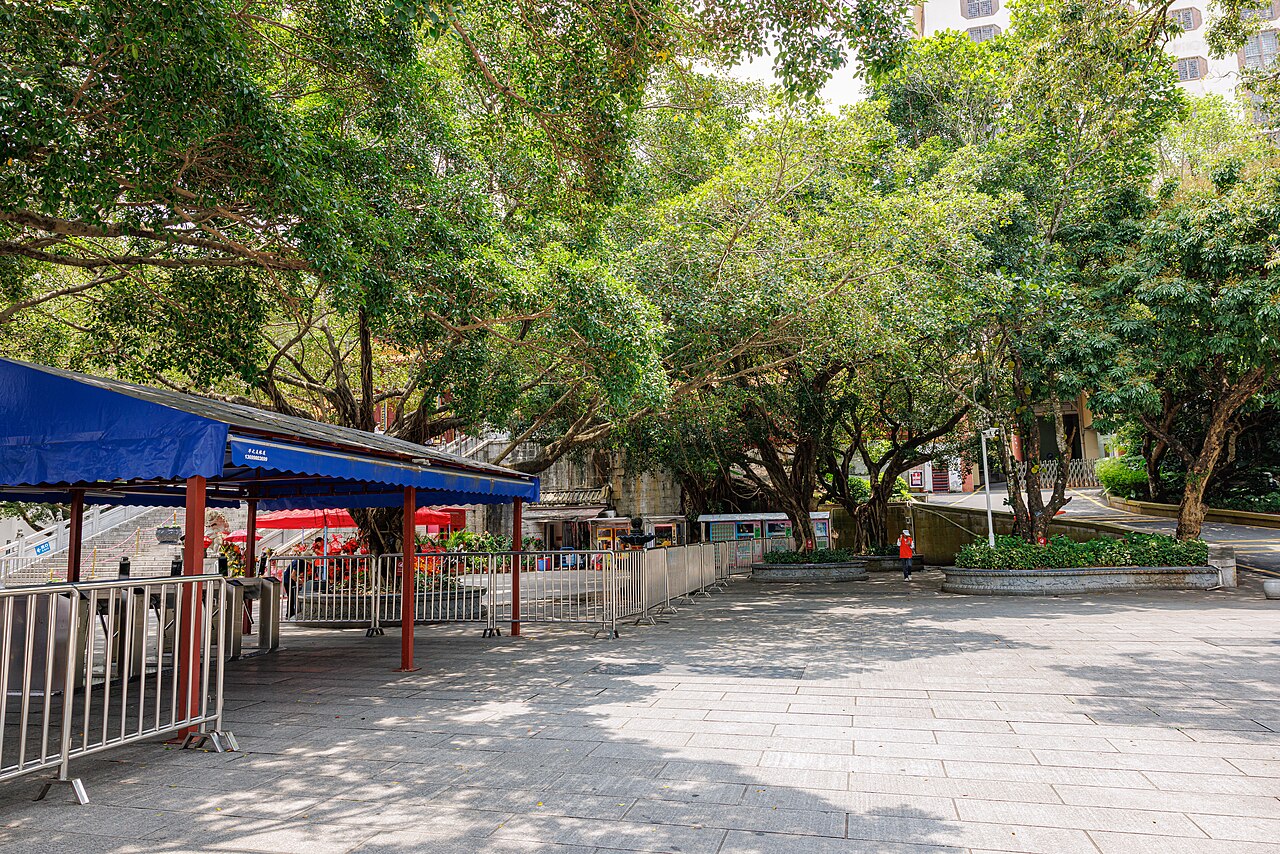
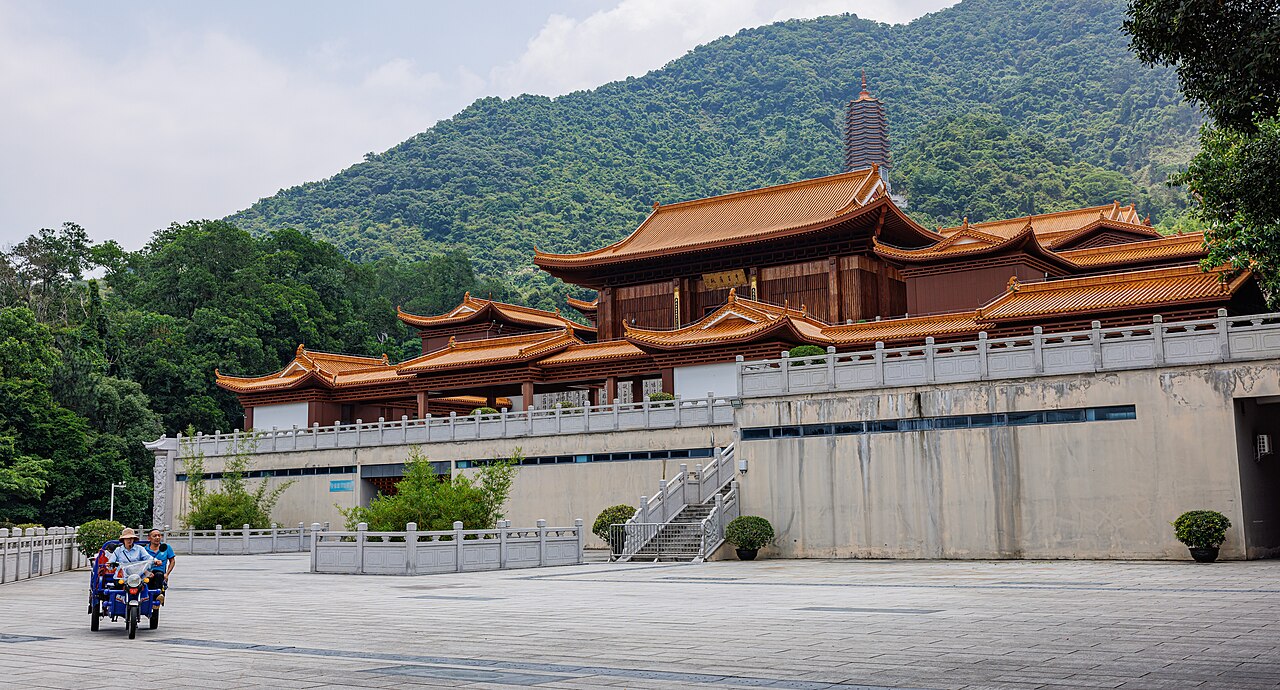
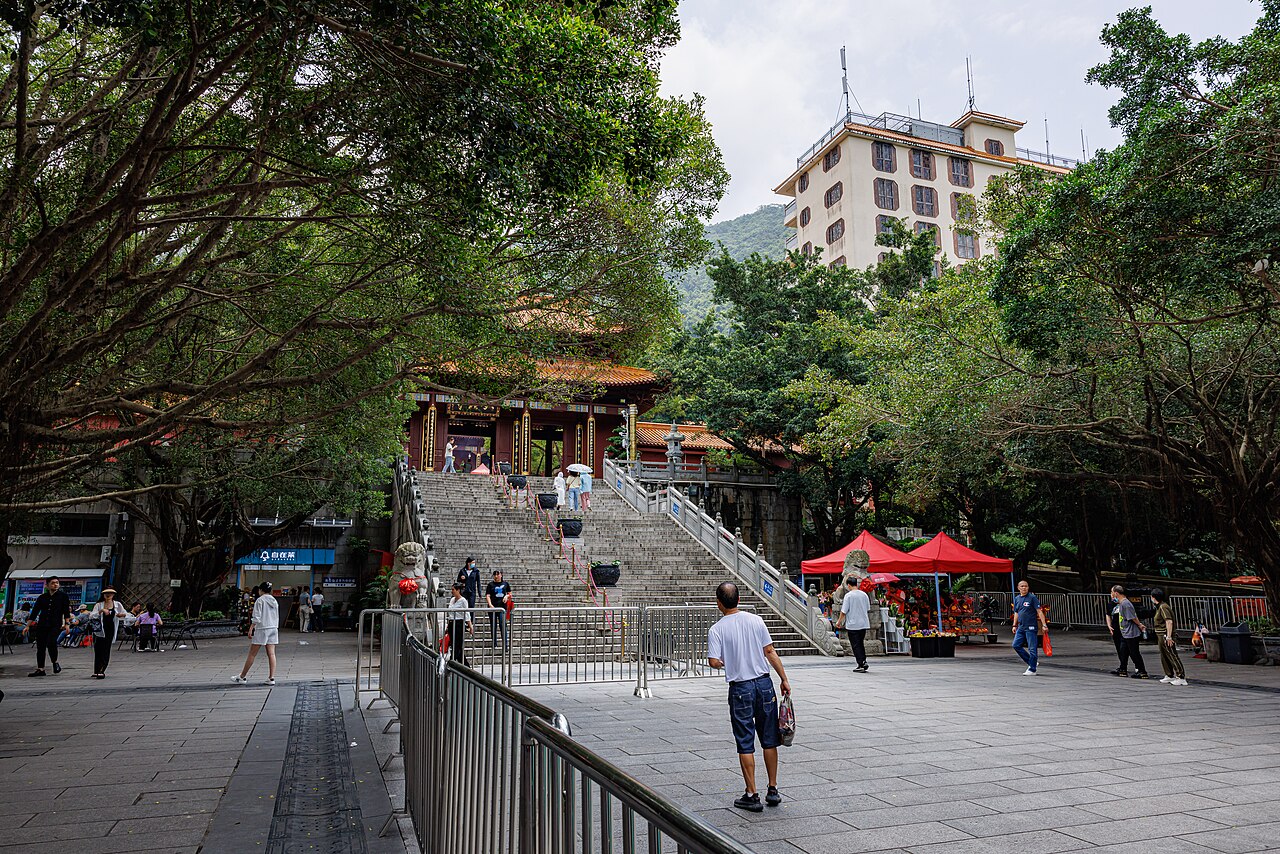
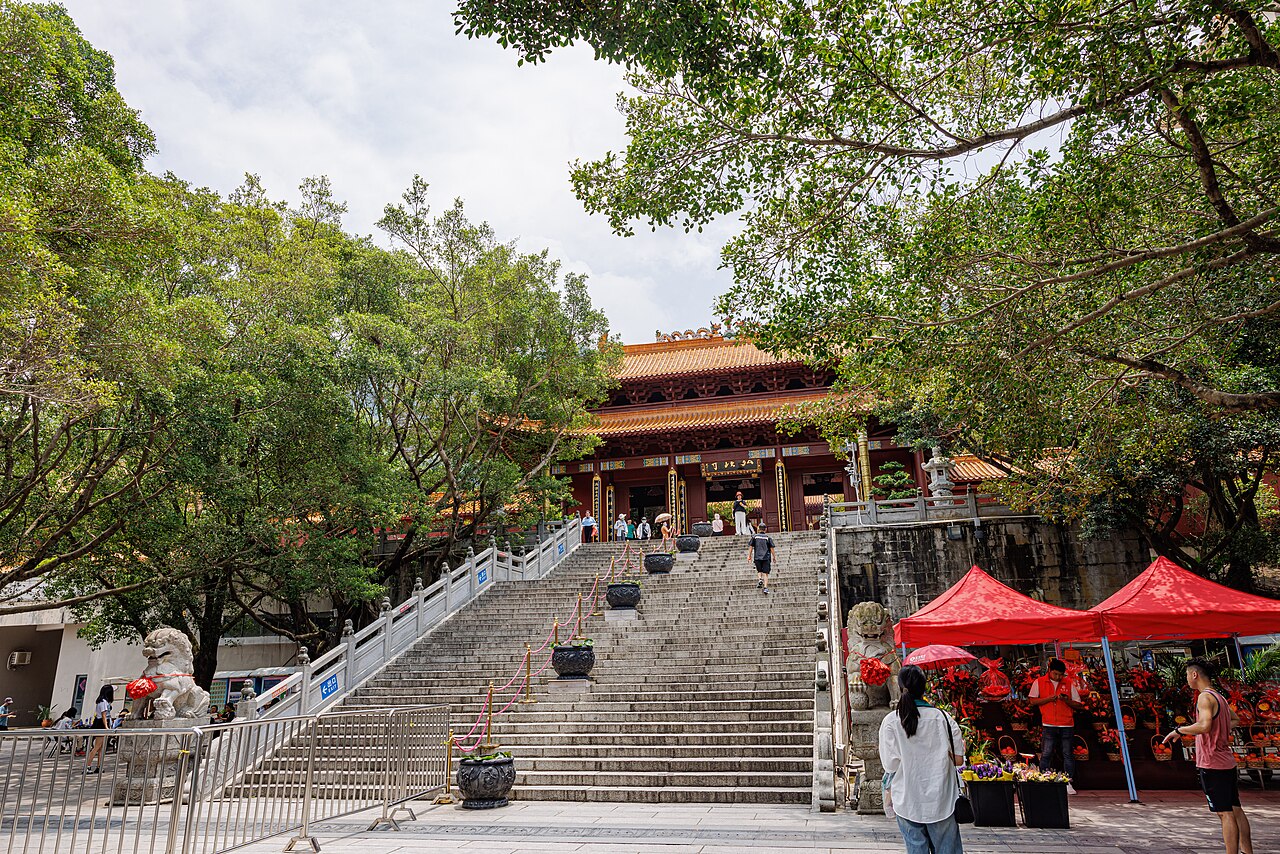
Hongfa Temple (弘法寺) is Shenzhen's largest Buddhist monastery, set inside Fairy Lake (Xianhu) Botanical Garden on the lower slopes of Wutong Mountain in Luohu District. Ground was broken on 1 July 1985, making it widely cited as the first entirely new Buddhist temple built in the People's Republic of China; it opened to the public in 1990 and its main halls were completed in 1992 alongside the enthronement of its founding abbot, Venerable Benhuan. Today it is led by Venerable Yinshun in the Linji Chan lineage and remains the busiest incense-burning temple in the city, packed on the 1st and 15th of each lunar month and during Spring Festival. Treat it as a working monastery paired with a botanical-garden walk rather than a museum piece — half a day covers both comfortably.
The central-axis layout of roughly forty structures — mountain gate, Hall of Heavenly Kings, Mahavira Hall, Guanyin Hall and the scripture repository — arranged to face outward with Wutong Mountain at its back.
Traces of founding abbot Benhuan (1907–2012, who died at the age of 106), one of modern Chinese Buddhism's most revered elders, recorded through the Patriarch Hall and the temple's own historical displays.
Views from the terraces down over Fairy Lake and Shenzhen Reservoir — a striking contrast of monastery eaves against one of China's most modern skylines.
The 'civilised incense' practice: three free sticks collected at the entrance and lit only at designated censers, a good window onto how mainland temples have reformed offering customs.
The temple's vegetarian dining hall and free midday meal (generally around 11:00–12:30), serving Cantonese-style monastic food — availability and hours vary, so check on arrival.
The garden's electric shuttle loop that begins and ends at the temple, linking the lake area, bonsai garden, desert plant section and fossil forest.
Good to know
RulesThe temple itself is free, but you must hold a ticket to Fairy Lake Botanical Garden (reported at roughly RMB 15 adult / RMB 5 child — verify the latest). E-tickets are sold only through the official WeChat accounts or mini-programs '深圳市仙湖植物园' and '美丽深圳', with real-name details required; tickets bought on third-party platforms may be refused at the gate.
RulesMany nationalities, including South Korean passport holders, currently have visa-free entry to mainland China for stays of up to 30 days through 31 December 2026; the exemption cannot be extended or converted in-country. Check your own nationality's status with a Chinese embassy before departure, and confirm temporary-residence registration rules if you are not staying in a hotel.
RulesTicketing, the garden shuttle and parking reservations all run through WeChat, so install Alipay or WeChat Pay and link an international card (Visa, Mastercard, JCB) before you arrive. Cash and direct foreign-card swipes are frequently not accepted. Google Maps, Google services and several messaging apps are restricted on the mainland — arrange roaming from your home carrier or another workaround in advance.
SeasonOn the 1st and 15th of the lunar month and across Spring Festival, crowds surge and the garden switches to advance booking, headcount caps and timed entry (for 2026 Spring Festival, controlled access ran 16–23 February, 08:00–18:00). During these periods visitors may not bring their own incense and must use the free sticks issued by the temple. June to September is hot, humid and typhoon-prone — go in the morning.
MannersPhotography is prohibited inside many halls; look for signage first and never point a camera directly at an image of the Buddha. Step over thresholds rather than on them, remove hats indoors, and keep your voice down. Cover shoulders and knees, and if you accept the free vegetarian meal, take only what you will finish.
SafetyThe garden is built on hillside terrain, so expect slopes and stairs between the main gate and the temple. Walking is feasible, but a paid shuttle runs the route (around RMB 3 one way, roughly 8 minutes). Private cars cannot enter the grounds; use the multi-storey car park at the main gate, which requires advance booking on weekends and public holidays.
CautionWorship and incense are free, and donations are entirely voluntary. You are under no obligation to buy expensive incense, amulets or 'blessing fees', or to give a specific sum when pressed. Be wary of unlicensed touts offering parking or rides outside the gate, and of amulet stalls that have no connection to the temple.
Practical info
Take Shenzhen Metro Line 2/8 to Xianhu Road Station (仙湖路站), Exit C/C3, then walk 8–10 minutes to the botanical garden's main gate; buses 202, 220, 363, 382 and B955 also terminate at Fairy Lake Botanical Garden. The garden generally operates 08:00–18:00 and Hongfa Temple charges no separate admission beyond the garden ticket (about RMB 15 for adults), but hours, prices and whether advance booking is required change by season — confirm the latest on the garden's official WeChat account or website shortly before you go.
On-site reviews📍 Verified on-site
No reviews yet. If you are here, be the first to leave one.