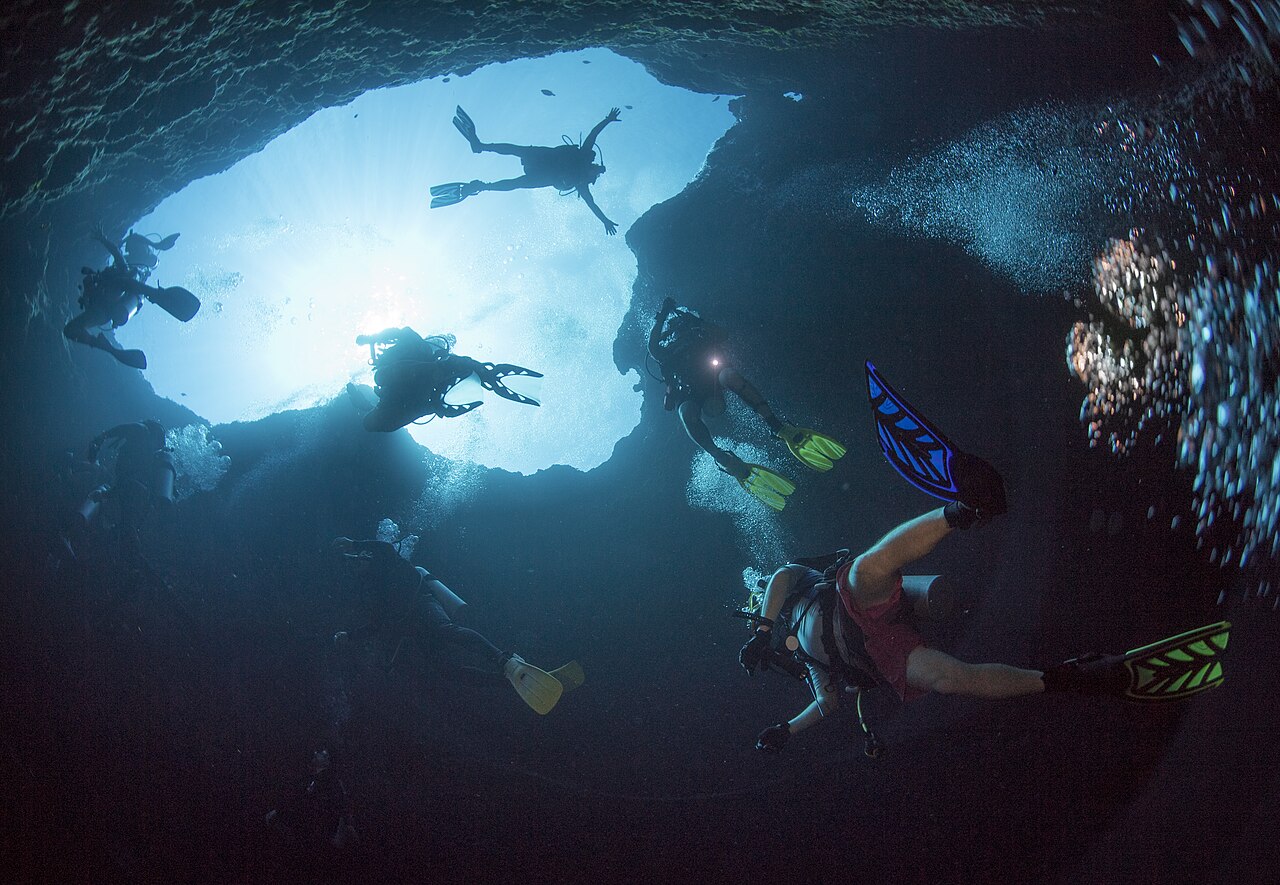
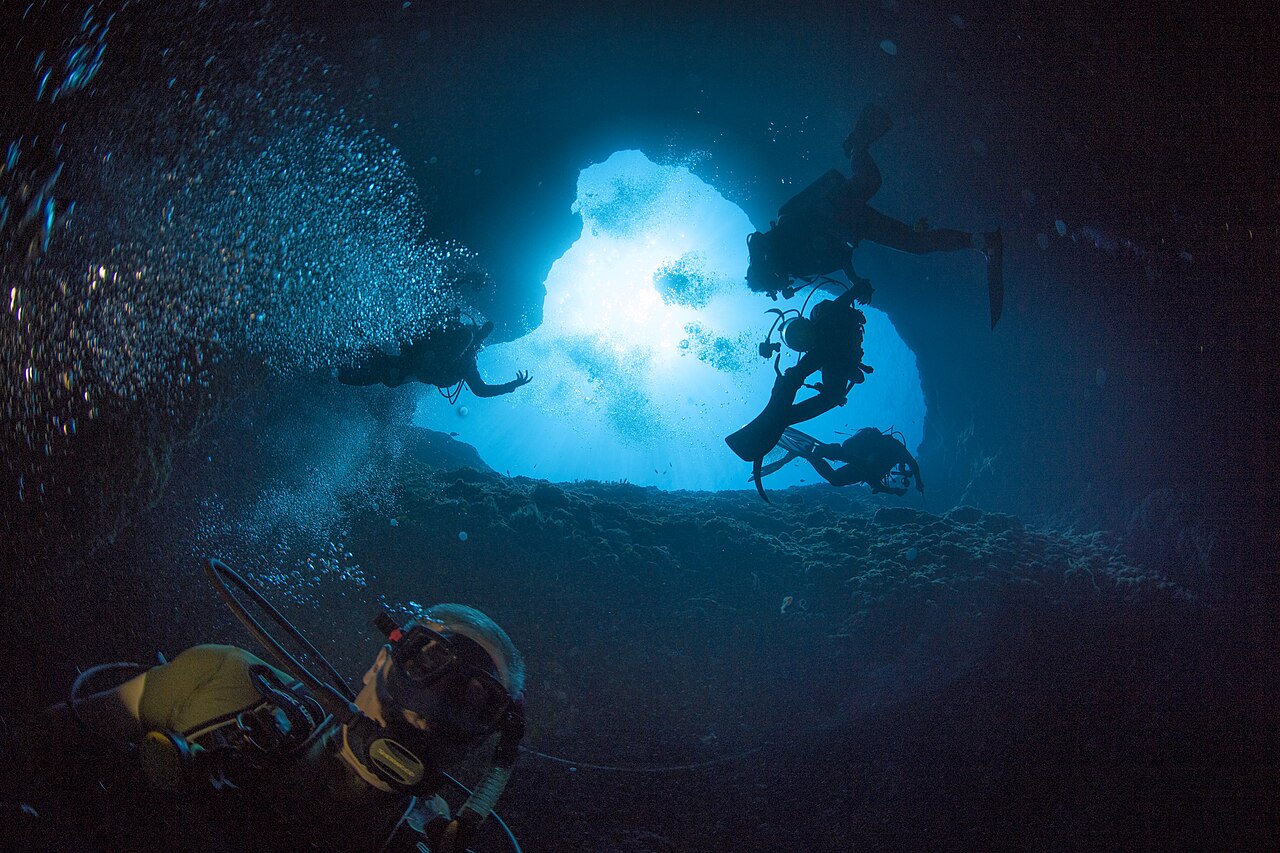
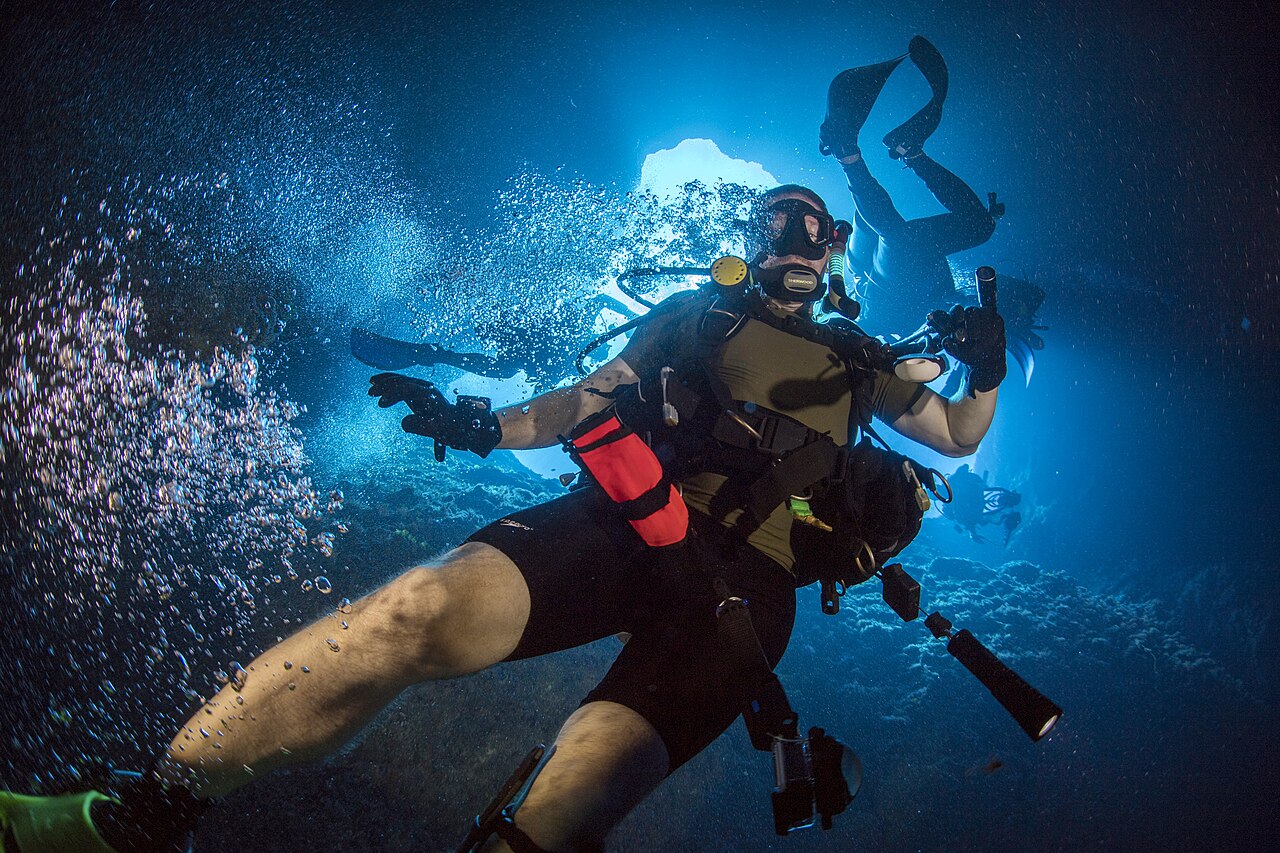
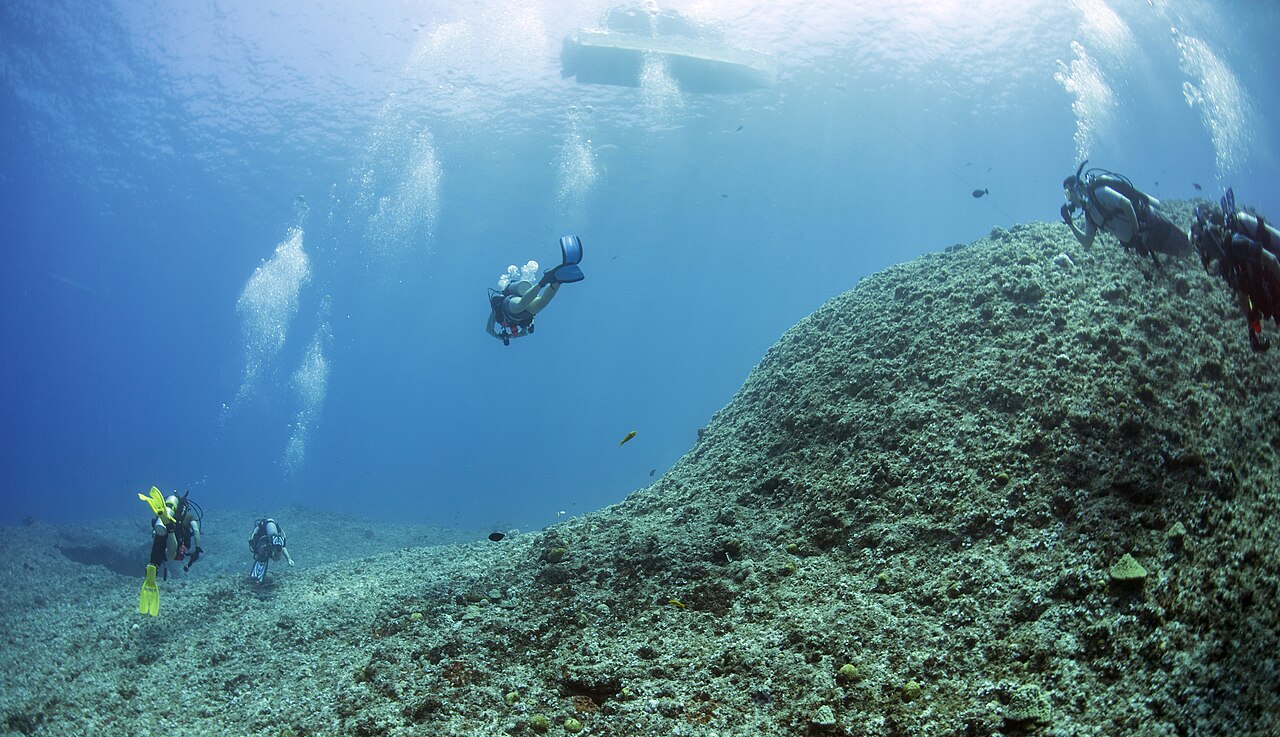
The Blue Hole is a limestone shaft in the wall off the Orote Peninsula, at the northern edge of Agat Bay on Guam's west coast. Its heart-shaped mouth opens at roughly 50-60 ft (15-18 m), drops vertically to a large "window" that breaks through the outer wall at about 125-130 ft (38-40 m), and continues into darkness past 300 ft (90 m). Visibility averaging around 100 ft and water sitting at 27-29 degrees C year-round are what draw deep freedivers here: warm, clear, and reachable. It is worth being clear that in 2026 this remains a scuba boat site. Nothing about the standard charter is built for freediving, so line, lanyard and safety cover are yours to arrange.
The heart-shaped opening at 15-18 m, most legible when you look straight down into it from above
The vertical shaft itself, running clean from the mouth down to the 38-40 m exit
The "window" punching out through the outer wall, and the drop-off beyond it
Large sea fans across the wall, with blacktip sharks, barracuda schools and green turtles working the edge
Small reef species including the Guam pencil dottyback (Lubbockichthys myersi), first described from this site in 2004
Good to know
SafetyThe shaft and the window traverse are an overhead environment. For a freediver, overhead means that a blackout cannot end in a float to the surface, and that makes it a fatal geometry rather than a difficult one. "Shooting the hole" is framed as a deep scuba route, not a breath-hold route. If your plan involves passing through on a single breath, the correct answer is to not do it.
SafetyShallow water blackout and LMC cluster in the last 10 m of ascent and in the first 30 seconds on the surface. Run strict one-to-one buddying: a safety diver meeting you around 15 m and holding eye contact through a full 30-second surface protocol. Other people being in the water nearby is not supervision.
SafetyA 40 m dive here only works with a proper descent line, lanyard and counterballast rigged. The bottom is open past 90 m, and without a line you lose depth awareness and orientation at the same time. You will need to bring and rig that setup yourself; riding along on a scuba charter does not provide it.
SafetySheer cliffs mean boat access only, and any emergency runs back toward Apra Harbor. The US Naval Base Guam recompression chamber is effectively the island's only multiplace chamber and has long treated civilian divers, but intake, transport and cost are separate questions from availability. Do not dive here without diving insurance such as DAN.
RulesOperators typically require advanced or deep certification, and for freediving will expect AIDA 3 / SSI Level 2 or above plus recent deep logs. Apra Harbor is a US Navy-controlled port and boat movements are handled through licensed operators, so do not attempt to reach the site by private boat or an informal charter.
SeasonJanuary to May is the dry season and gives the calmest seas and best visibility. July to November is the wet season with typhoon risk peaking July to September, so treat bookings in that window as cancellable. Current outside the window runs eastward, making SMB deployment on exit and an agreed boat pickup non-negotiable.
MannersUse the mooring buoy rather than anchoring, keep hands and fins off the sea fans, and give turtles and sharks room instead of pursuing them for footage. Take nothing from the site.
Practical info
Guam (GUM) is served by direct flights from across East Asia; from the airport it is roughly 30 minutes by road to Cabras Marina in Apra Harbor, then about 20 minutes by boat to the site. Aim for the January-to-May dry season, confirm your entry authorisation before departure (visa waiver rules and the G-CNMI ETA / Guam EDF requirements changed in recent years), and check current pricing, departure times and certification requirements directly with operators, as these change often.
On-site reviews📍 Verified on-site
No reviews yet. If you are here, be the first to leave one.