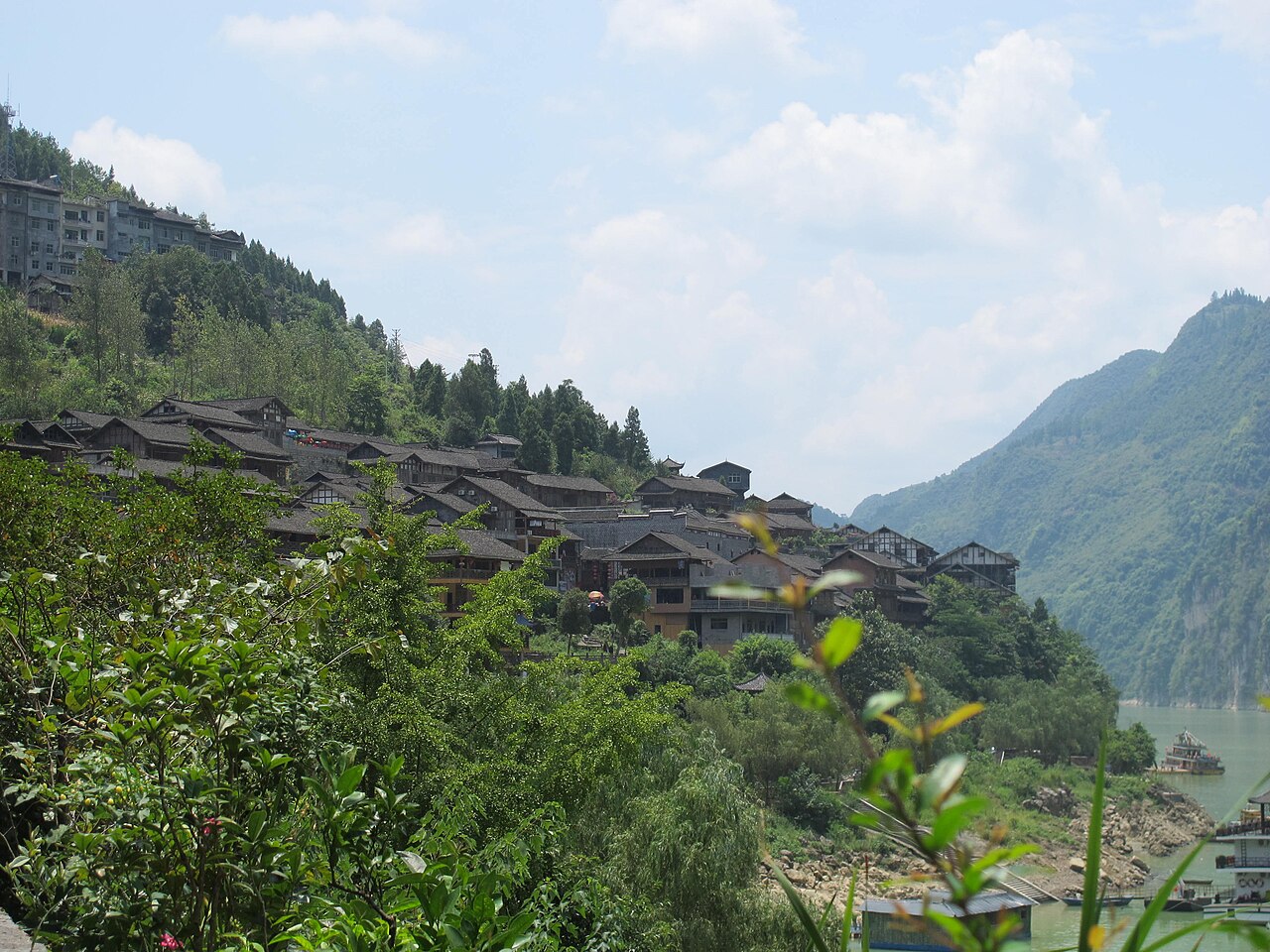
Gongtan Ancient Town clings to a cliff above the Wujiang River in western Youyang Tujia and Miao Autonomous County, Chongqing, where the Apeng River joins the Wujiang, and traces its history back some 1,700 years. Rapids here forced boats to transfer their loads, and from the Ming and Qing dynasties that made Gongtan the Wujiang's busiest salt and freight port; roughly 1.3 km of blue-flagstone street and more than 400 Tujia diaojiaolou (stilt houses braced against the slope) survive, earning it status as a Chinese Historic and Cultural Town and a national AAAA rating. What you see, however, is not on the original site: when the Pengshui hydropower reservoir was set to submerge the old town, its timber buildings were dismantled, numbered and rebuilt about 1.5 km away, reopening in May 2009. With the Chongqing East–Qianjiang section of the Yu-Xia high-speed railway open since 27 June 2025, access has improved sharply — come to see a village transplanted whole and the Wujiang gorge around it, rather than an untouched ruin.
Xiqin Guild Hall (西秦會館) — built by salt merchants from Shaanxi and the largest structure in town, with intangible-heritage performances staged here regularly so you can see the building and the living tradition together.
Wu Guanzhong Memorial Hall (吳冠中紀念館) — the painter described Gongtan as 'a Tang street, a Song town, grandpa and grandma's house,' and his celebrated work 'Old Street' was born here. The upper floor shows nine paintings of Gongtan alongside manuscripts and personal effects — effectively the only window onto how the town looked before the flooding.
The Ran and Xia family courtyards and the Dong ancestral hall — Qianlong-era clan mansions now open as house museums, showing how a courtyard plan was adapted to a steep, cramped hillside for light and drainage.
Qiaochongqiao (橋重橋) and the old bridges — a dozen-odd stone bridges survive with nicknames like 'the bridge you cross without seeing a bridge' and 'eighteen bridges on one road'; the best known stacks one bridge directly on top of another.
The Wujiang Gallery cruise and the river views — boats leave from Gongtan into the gorge, passing formations such as Goddess Peak and Peacock Mountain and the old towpaths cut into the cliff face; daytime and evening sailings run separately.
The evidence of the move itself — numbers marked on the timbers during dismantling and reused original members are still visible in columns and beams. Knowing the whole settlement was carried uphill and rebuilt changes how every building reads.
Good to know
SeasonChongqing is in a record heatwave in July 2026. A municipal red high-temperature alert on 14 July forecast 40–42°C across 31 districts and counties including Pengshui, with further red alerts on the 15th and 16th; rain from 18 July should ease temperatures to roughly 30–36°C. Gongtan sits inside the Wujiang gorge, which traps heat, and the whole town is stairs and slopes — visit early morning or towards sunset rather than midday. Conversely, heavy summer rain raises the river and cruises get cancelled, so reconfirm boat departures the morning of your visit.
SafetyThe journey, not the town, is the real variable. From the high-speed rail stations (Pengshui West or Qianjiang) it is another one to two hours by road, on winding cliffside roads along the Wujiang — motion sickness is common and night driving is not advised. Intercity buses generally run in daylight hours only, so check the last departure before you set out, and plan an overnight stay rather than a same-day round trip from central Chongqing.
RulesPayment runs on Alipay or WeChat Pay. Before you travel, link an international card (Visa, Mastercard, JCB and others are supported) and complete passport identity verification in the app. That said, this is a small mountain town where some stalls and local buses are still easier with cash, so carry some small notes as backup. Limits and fee thresholds change often — confirm current terms in the app.
RulesChina's unilateral visa-free entry covers ordinary passport holders from a long list of countries, including South Korea and Japan, for stays up to 30 days, extended through 24:00 on 31 December 2026; other nationalities, including the US, must check requirements and apply in advance. If you stay anywhere other than a hotel you must register your accommodation within 24 hours of arrival, and since 20 March 2026 Chongqing has been a pilot region where this can be done online via the National Immigration Administration platform. Note that small guesthouses in towns like Gongtan sometimes lack the registration system for foreign guests and will turn you away — confirm they can accept foreigners when booking, and carry your physical passport.
RulesExpect a different internet. Google Maps, YouTube, Instagram, WhatsApp, Line and many other foreign services are blocked on mainland networks, and gorge terrain means patchy signal in places. International roaming from your home carrier, or a roaming-based eSIM that routes traffic outside the mainland, is the most reliable option; do not rely on VPNs, as unapproved VPN use can breach Chinese law. Download offline maps and translation packs before you arrive.
CautionBe wary of touts for boats and cars. Official sales are handled at the visitor centre; vessels or private drivers who approach you near the jetty offering a negotiated price have unclear insurance and safety standing. Wujiang fish, the signature restaurant dish, is often priced by the jin (500g) at market rate — agree the weight, unit price and expected total before ordering, and read the final amount on screen before scanning the QR code.
MannersThis is a living Tujia and Miao community, and its ancestral halls and temples are working religious sites. Some interiors restrict photography, and you should ask before taking close-up shots of residents or performers. Lanes are narrow and the houses are timber, so sound carries — keep noise down at night. Wet flagstone steps become very slippery in rain, so wear shoes with grip.
Practical info
From Chongqing East, the Yu-Xia high-speed railway (open since 27 June 2025) reaches Pengshui West in about 41 minutes and Qianjiang in about 66 minutes; from there it is a further one to two hours by intercity bus, taxi or chartered car (roughly 65 km from Youyang county town). The streets themselves are unwalled and open, but posted scenic-area hours are 08:30–17:30, a town maintenance fee of 16 RMB per person applies, and Wujiang Gallery cruises run around 158 RMB by day and 98 RMB in the evening. Fares, sailing times, opening hours and seasonal ticket-exchange offers all change frequently, so verify the latest details through official channels or the tourism hotline (023-75677000) immediately before you go.
On-site reviews📍 Verified on-site
No reviews yet. If you are here, be the first to leave one.