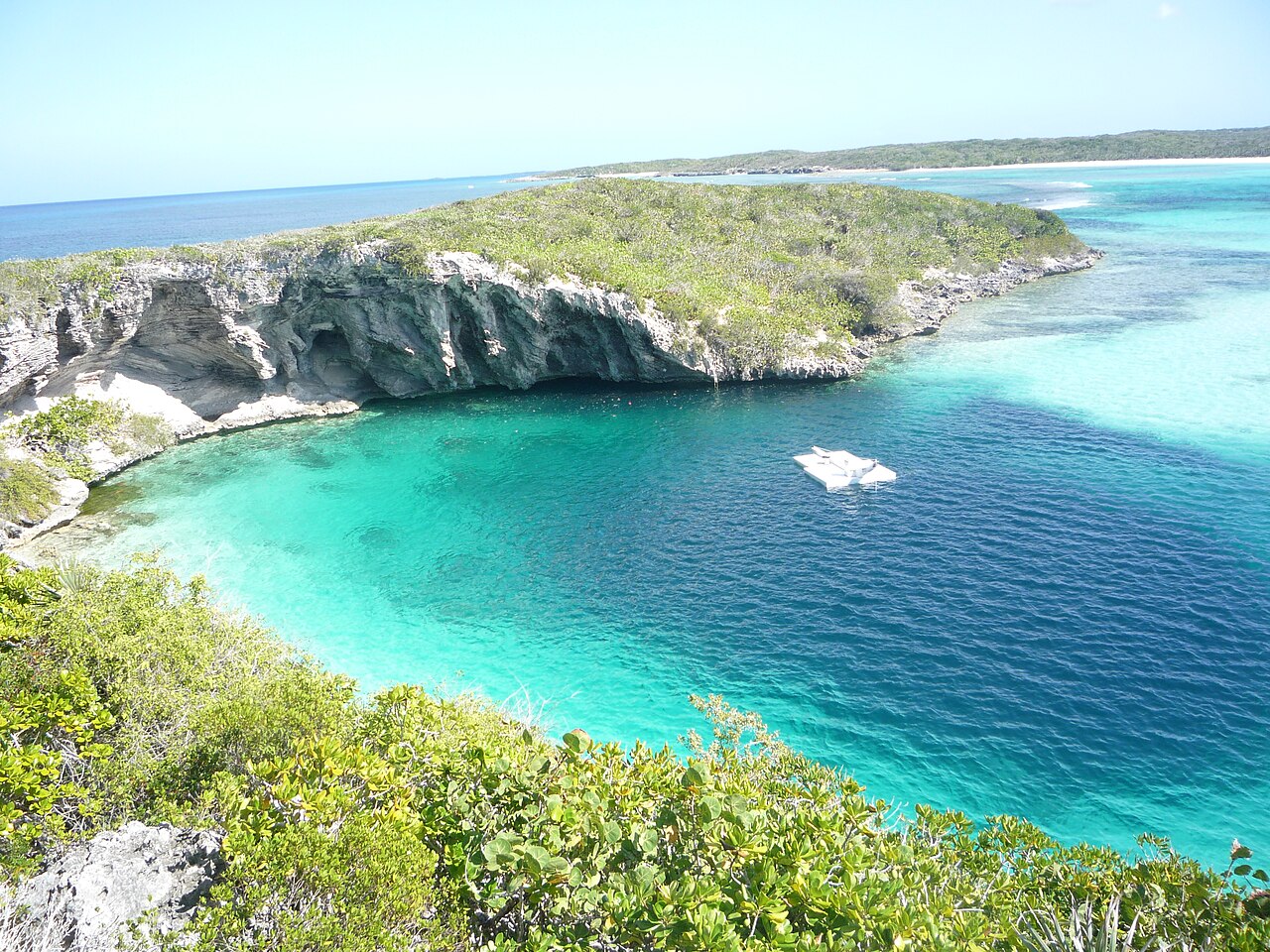
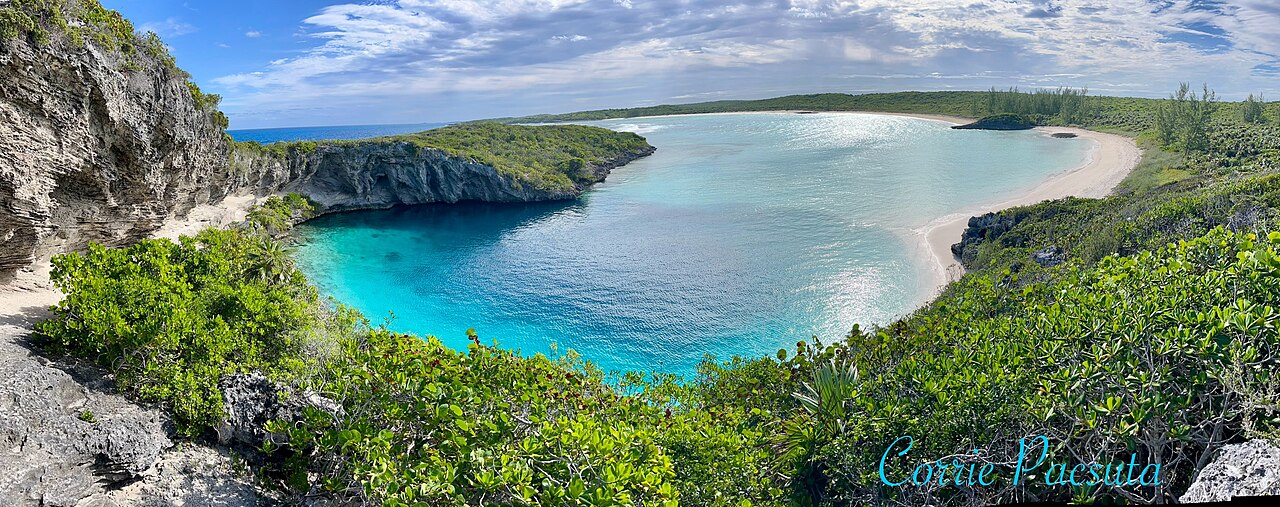
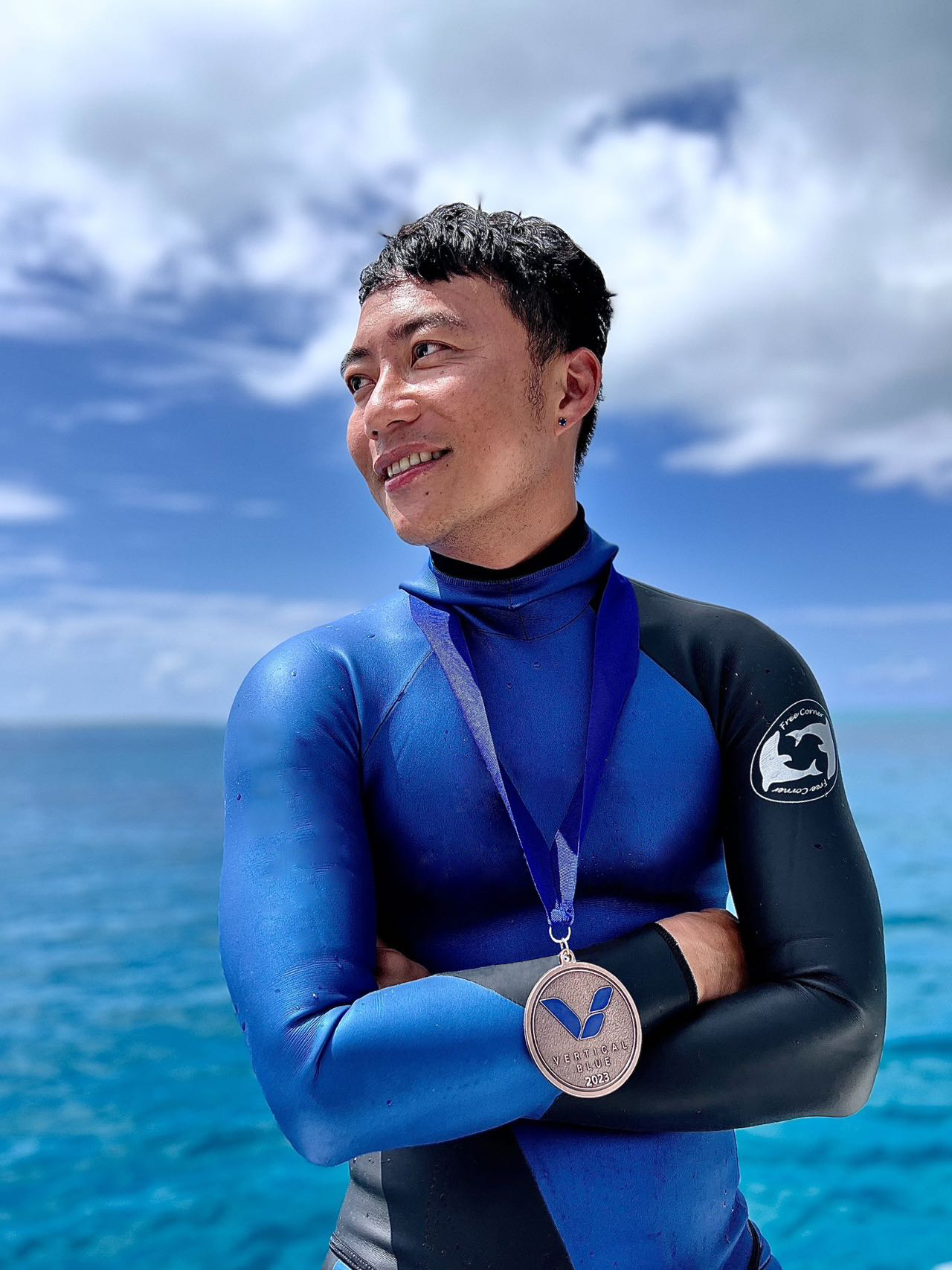
Dean's Blue Hole is a 202m (663ft) saltwater sinkhole in a bay west of Clarence Town on Long Island, Bahamas — the third deepest blue hole on Earth after Taam Ja' in Mexico's Chetumal Bay and the Dragon Hole in the South China Sea. Twenty paces from the sand the bottom simply falls away, and because the site sits inside a bay ringed on three sides by limestone cliffs, there is almost no swell or current: it is one of the very few places on the planet where you can reach a deep line on foot, without a boat. That combination made it the permanent home of Vertical Blue, the invitation-only competition founded by William Trubridge, and the setting for more freediving world and national records than anywhere else. Water runs 24–29°C year-round with visibility typically 15–30m, and as of 2026 the beach remains open with no known entrance fee — but outside competition and school sessions there is no lifeguard and no line in the water.
A walk-in entry with no boat and no shore dive logistics — a few dozen steps and you are floating over hundreds of metres of water, the most accessible deep line in the sport
The bell-shaped profile: a surface opening roughly 30m across that widens underwater into a cavern about 100m in diameter, giving the site its signature silhouette when you look back up toward the light
A natural rock amphitheatre on three sides that keeps the surface glassy and the rope steady — conditions almost impossible to find at open-ocean depth sites
Waist-deep sand flats and a 100m-plus deep line sharing one location, so a first duck-dive lesson happens metres away from an elite depth session
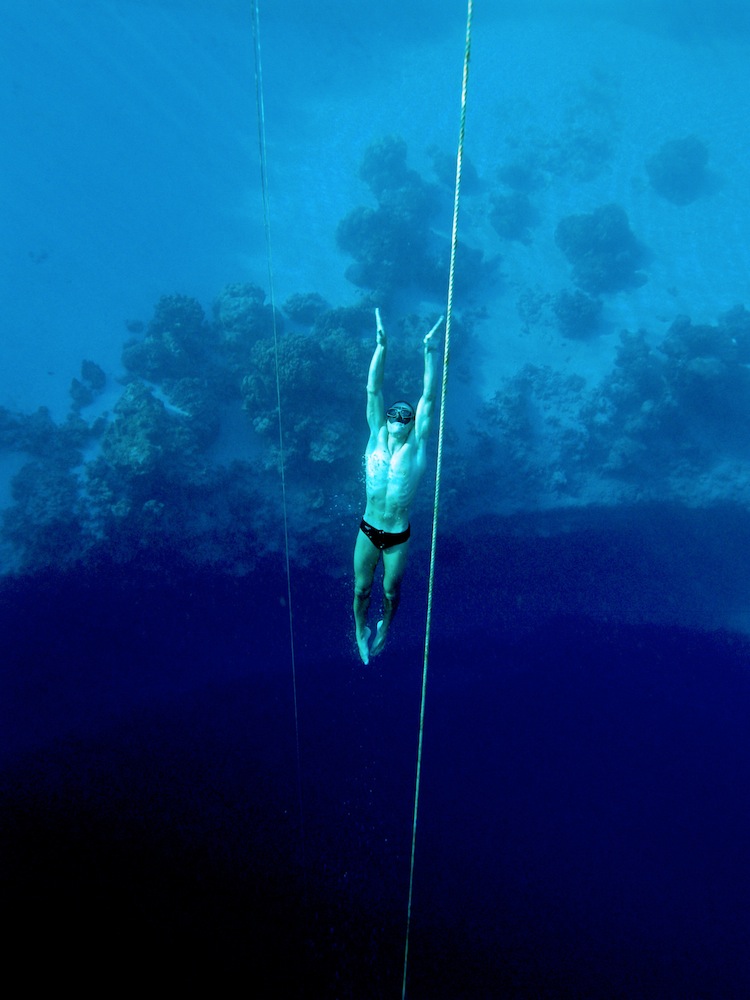
During Vertical Blue, the full competition rig — counterballast, safety divers, judged lines — is visible from the beach as records are attempted
The thermocline on descent, the limestone wall structure, and the hard colour line where turquoise shallows meet the ink-blue mouth of the hole
Good to know
SafetyNever dive here alone. Shallow water blackout and LMC arrive without warning, usually in the final 10m of ascent, and an unconscious freediver sinks from the surface within seconds. Use a trained buddy who meets you at depth on the way up and watches you for at least 30 seconds after surfacing, one-down-one-up, every dive. The belief that a shallow session doesn't need a buddy is the single most common path to a fatality in this sport.
SafetyAmerican freediver Nicholas Mevoli died here on 17 November 2013 during a Vertical Blue competition. That happened with safety divers, medical staff and a counterballast system all in place — the best-supported freediving environment that exists. This is not a place for a curious beginner to test how deep they can go; personal-best attempts belong only in coached sessions with a full safety setup.
SafetyThis is an overhead environment. Below the opening the hole bells outward, so swimming inside the wall puts rock above your head and removes any direct vertical escape to the surface. Do not penetrate the overhang or cavern without cave-level training and equipment, and always clip a lanyard to the line on deep dives so losing the rope in low light is never possible.
SafetyThere is no recompression chamber on Long Island. The nearest facility is the Bahamas Hyperbaric Centre at Lyford Cay in Nassau, and serious cases may need evacuation to South Florida. Carry dive insurance that explicitly covers freediving plus air medical evacuation — an uninsured evacuation runs into tens of thousands of dollars, and which insurers a given chamber accepts has changed before, so confirm current terms yourself before you travel.
RulesNo permanent line hangs in the hole. Deep-line access exists only during sessions run by local operators such as the Vertical Blue school, who set the line, buoy and safety divers; certification, recent depth experience and advance booking are normally required. Requirements, prices and operating hours change by season — check and book directly with the operator for current information.
SeasonJune through November is Atlantic hurricane season, bringing cancelled domestic flights, closed lodging and swell. April to July is generally the most settled window. Vertical Blue dates move year to year — 2025 ran 1–11 July, while the 2026 edition appears on the CMAS calendar in late June. If you are travelling to spectate, or specifically to avoid the competition crowd, confirm the final schedule through official channels.
CautionSome 'blue hole tour' packages sold in Nassau either visit a different blue hole on another island or quote a price that excludes the required domestic airfare. Dean's Blue Hole cannot be reached from Nassau by boat — it needs a flight to Long Island. Get the destination name and the round-trip flight inclusion confirmed in writing before paying.
Practical info
Fly into Nassau (NAS), then connect on a domestic flight to Deadman's Cay Airport (LGI) on Long Island — roughly 55 minutes with Bahamasair or a charter operator — and drive toward Clarence Town; there is effectively no public transport, so a rental car is necessary. The site is reached by parking and walking a short rocky path to the beach, with no entrance fee reported to date, but school courses and deep-line sessions require prerequisites and advance booking, and fees, opening hours and competition dates change frequently — verify all of it, along with current entry requirements for your passport, through official sources shortly before you travel.
On-site reviews📍 Verified on-site
No reviews yet. If you are here, be the first to leave one.