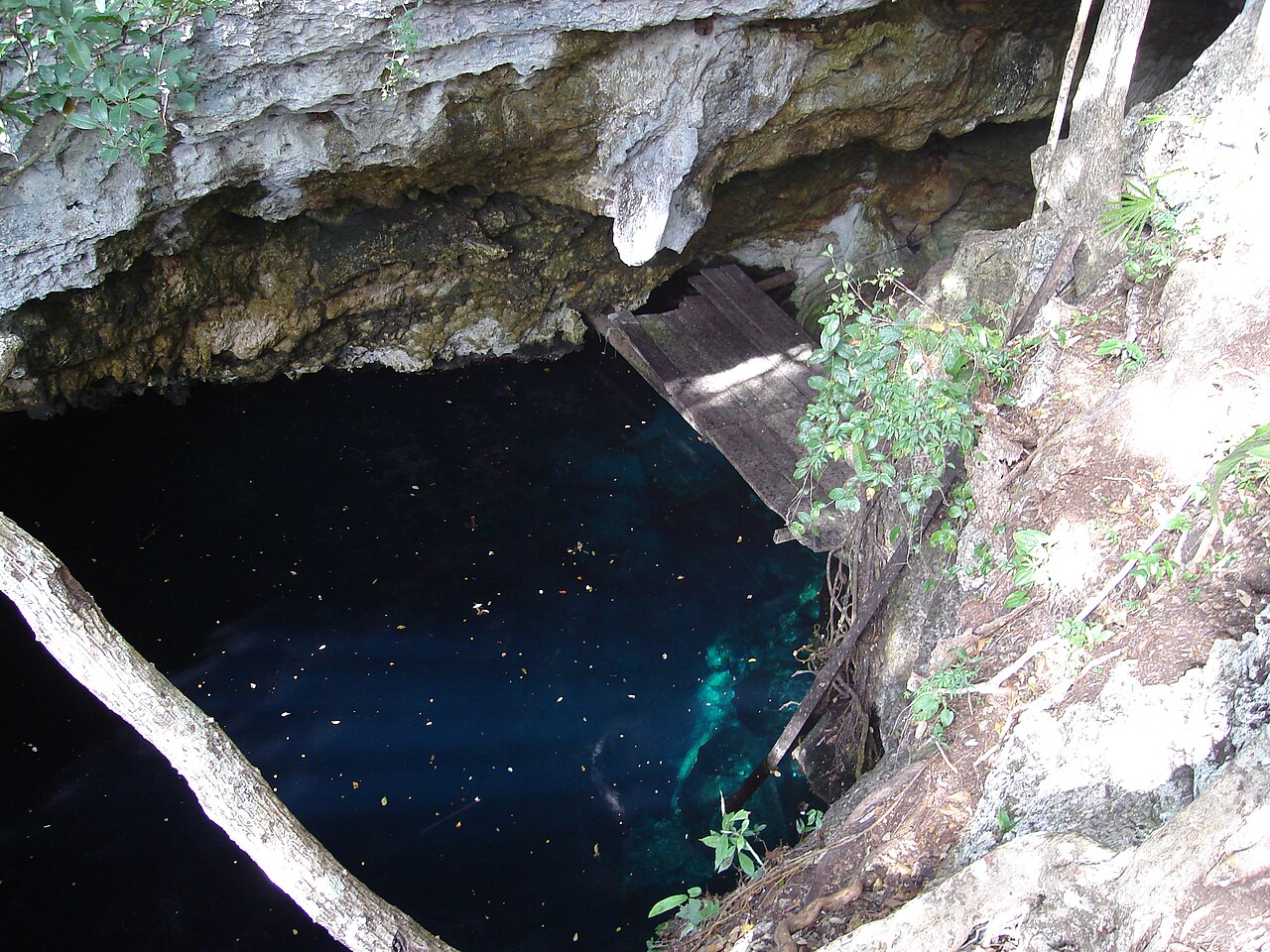
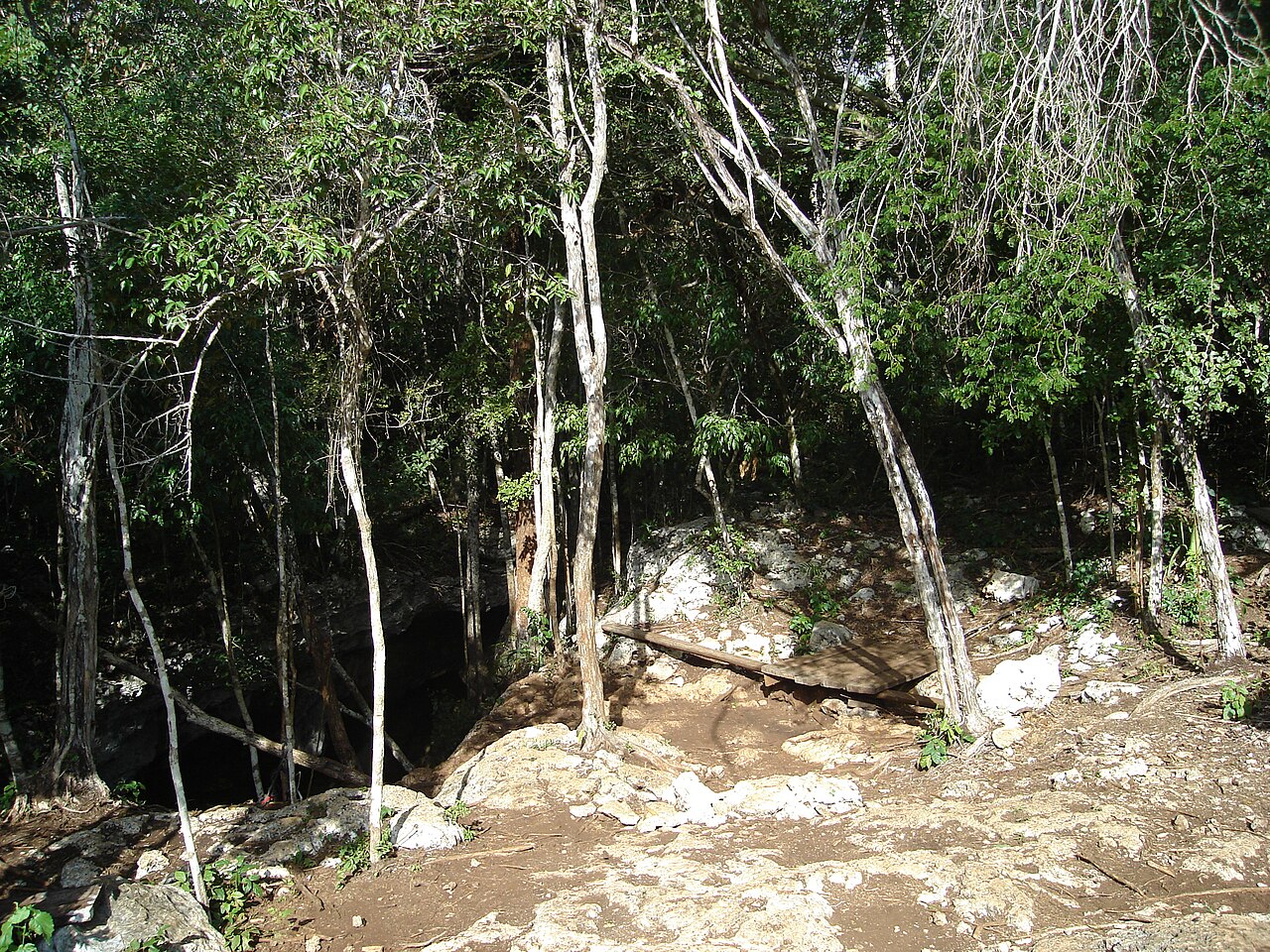
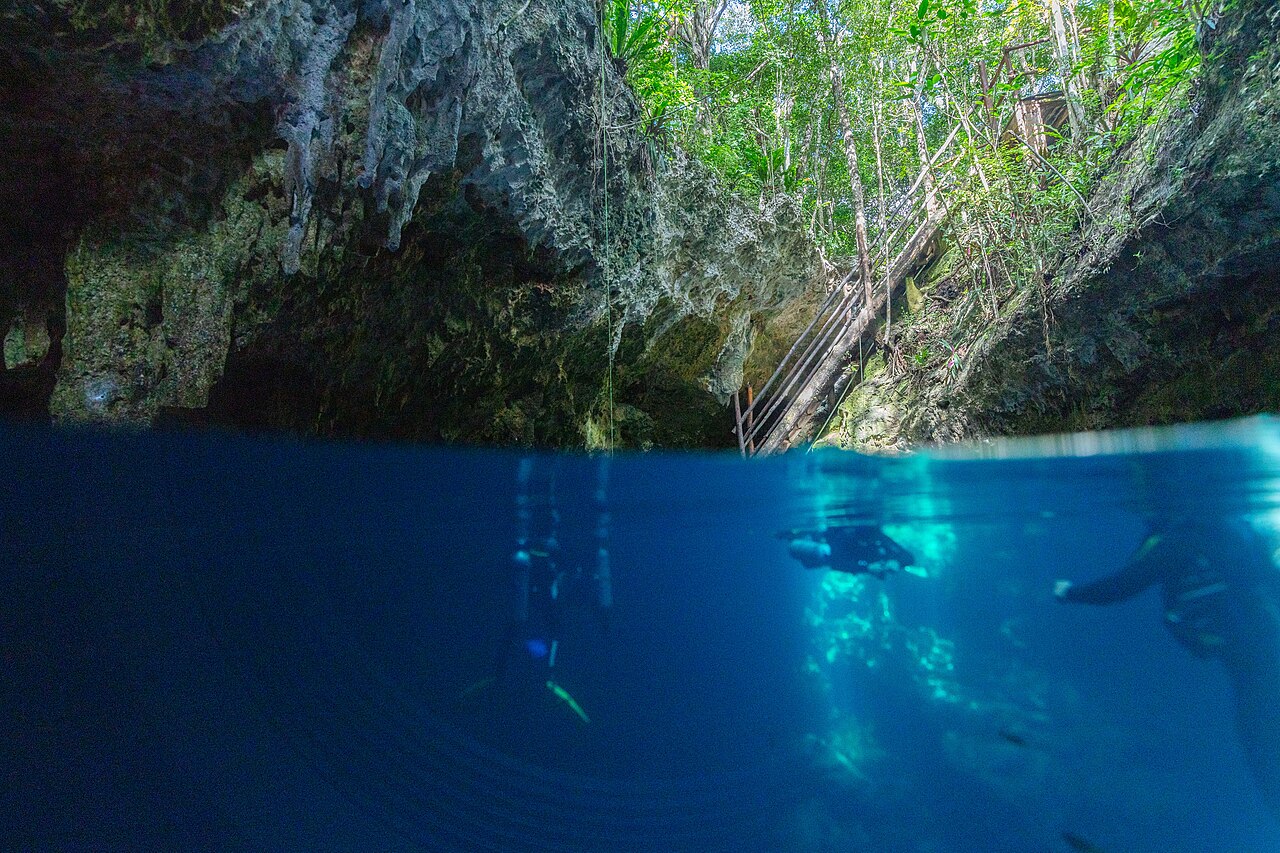
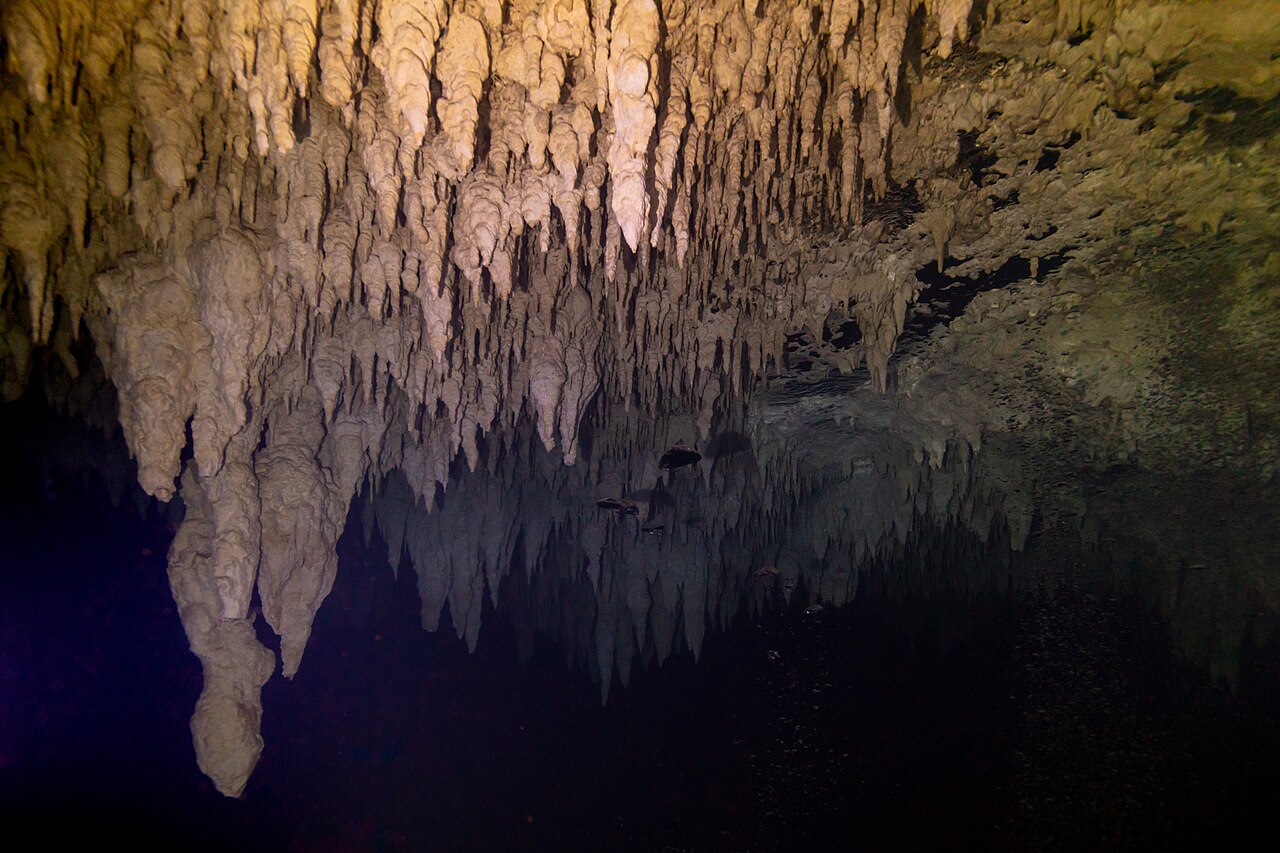
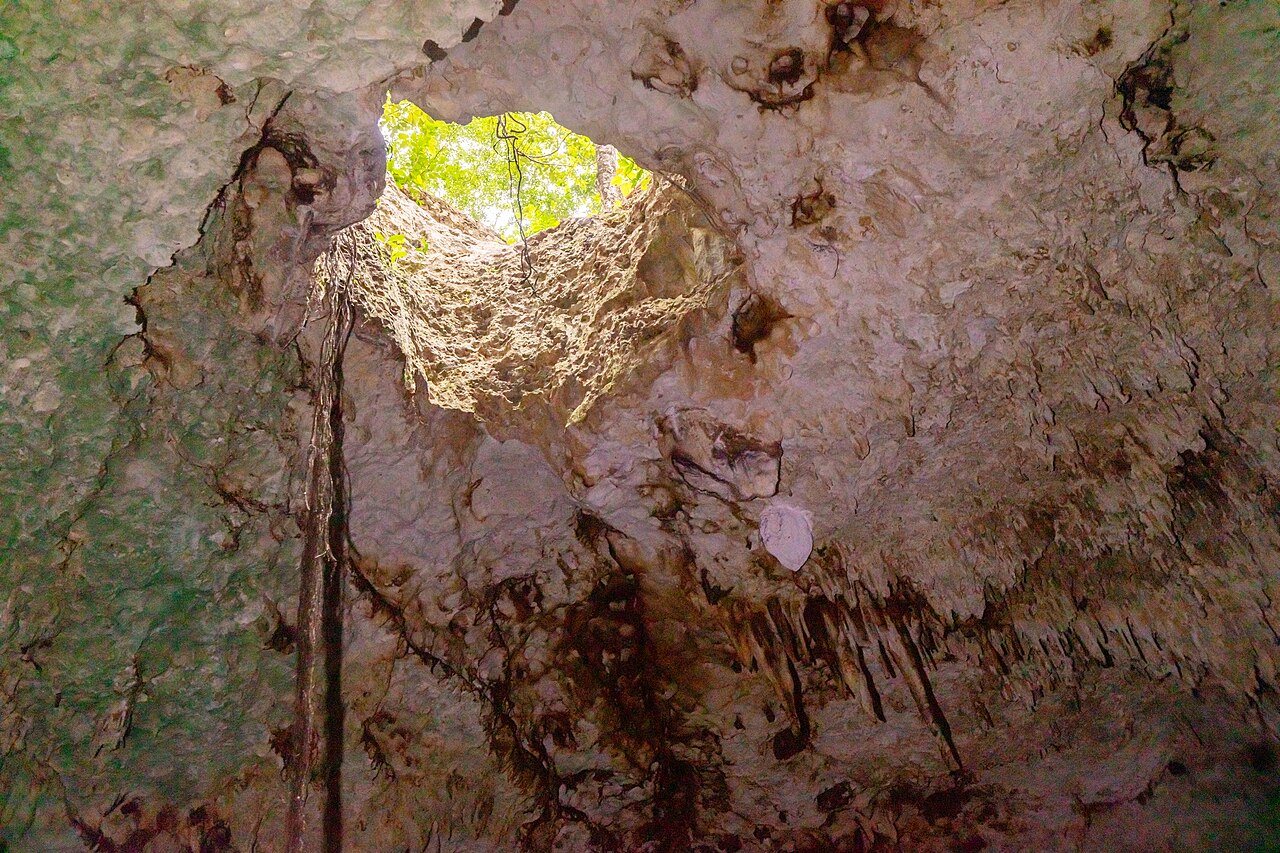
These two cenotes sit inside Dos Ojos Natural Park north of Tulum, both part of Sistema Dos Ojos — an 82 km freshwater cave system with 28 known cenote entrances. The Pit drops to 119.1 m, the deepest known passage in Quintana Roo, and owes its fame to the shafts of light that pour through its narrow opening near midday and to the hydrogen sulphide layer hanging around 30 m, which together have made it a signature backdrop for freediving and underwater photography. Water holds near 25°C year-round and is so clear that visibility is limited by available light rather than particulate. Be clear on one point in 2026, though: this is a guided dive site, not an open training site — serious depth-line work around Tulum happens at Cenote Angelita (roughly 85 m) and Laguna Kaan Luum (roughly 75 m).
The Pit's vertical shaft — 119.1 m deep, found in 1996 about 1.5 km from the main entrance and still the deepest surveyed passage in Quintana Roo
Light beams roughly between 11:00 and 13:00; a clear sky around solar noon is what makes or breaks the shot
The hydrogen sulphide layer near 30 m, a white fog bank with submerged tree limbs rising out of it
Dos Ojos' shallow zone near the entrances (about 10 m maximum) — bright, still water that suits duck-dive and buoyancy refinement
No current, no swell, pure freshwater — the scene changes entirely with the sun angle rather than with the water itself
Good to know
SafetyNever dive alone. Shallow water blackout and LMC arrive without warning in the last metres of ascent, and one-up-one-down supervision with a 30-second surface watch is the only protocol that has ever reliably caught them. Calm, warm, glassy water does not lower this risk — it hides it.
SafetyBoth sites are overhead environments with substantial ceiling. The moment you are somewhere you cannot ascend straight to the surface, a freediving incident becomes effectively unrescuable. Riviera Maya cenotes carry a real fatality record — a multi-fatality incident in 1995, three deaths on a guided dive at Cenote Chac Mool in 2012 — and nearly all involved people who went beyond their training into cave passage. Without cave certification, do not pass the guideline or the point where natural daylight ends, for any reason.
SafetyBelow the hydrogen sulphide layer near 30 m the water is dark and toxic; freedive above it or on a managed line only. Freshwater gives less buoyancy than salt, so descents run fast and ascents run heavy — carrying a saltwater personal best straight into a cenote is how people fail on the way up.
RulesIndependent entry is not permitted; park rules require a certified cave or cavern guide. Operators commonly require Advanced Open Water or equivalent plus prior cenote dives for The Pit, and it is not a snorkelling site. Any freediving session must be agreed with an operator in advance — you cannot simply rig a line on arrival.
RulesIf you are diving a line, a lanyard is mandatory rather than optional, and safety-diver and counterballast responsibilities should be assigned before anyone gets in. Check that your travel insurance actually covers apnea — many policies exclude freediving or classify it as an excluded extreme sport.
SeasonDiveable year-round, but the November–April dry season gives the most dependable visibility and access. During the June–November rainy and hurricane season, runoff after heavy rain can cut visibility and affect roads and park operations. Chasing the light beams on an overcast day is largely wasted effort.
MannersCenotes are drinking-water sources for local communities and sacred sites in Maya culture. Rinse off sunscreen and cosmetics before entering — including products labelled biodegradable — and never touch formations, submerged trees or sediment. When scuba groups share the site, agree on line positions and stay clear of ascending divers and bubbles.
Practical info
Dos Ojos Natural Park is off Highway 307, roughly 1 to 1 hour 20 minutes by car from Cancún International Airport, about 20 minutes from Tulum and 40 from Playa del Carmen. Booking through a freediving or cenote diving centre in Tulum or Playa del Carmen is effectively the only way in; entrance fees, guide rates, certification prerequisites and whether freediving is permitted at all change with park and operator policy, so confirm current conditions directly before you travel.
On-site reviews📍 Verified on-site
No reviews yet. If you are here, be the first to leave one.