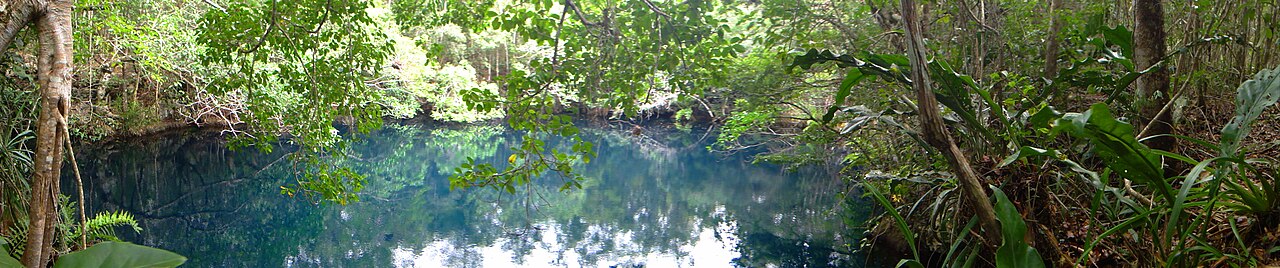
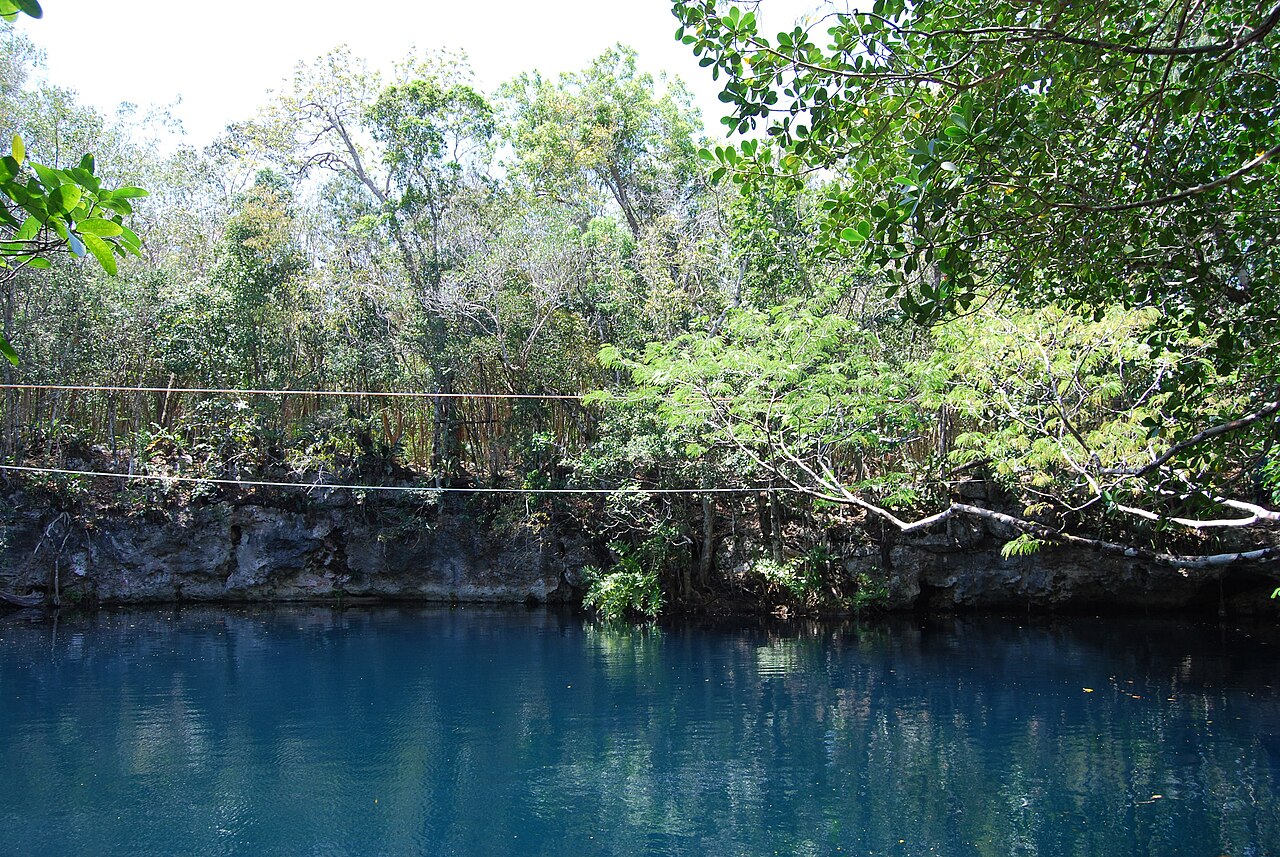
Cenote Angelita is an open, circular sinkhole in the jungle roughly 15–17 km south of Tulum, reached by a short walk in from the highway. At about 28–30 m a dense layer of hydrogen sulfide hangs across the shaft like a river of fog, with the bare branches of a long-dead tree breaking through it — the image that turned this cenote into one of the most photographed freediving sites anywhere. There is no current and no swell, the water holds at 25–26 °C year-round with 20–35 m of visibility, and the shaft is reported at roughly 56–60 m deep, so schools use it as a deep-line site; seeing the cloud, however, means being genuinely comfortable working at 25–30 m. As of 2026 access is through Tulum and Playa del Carmen operators on a booked, guided basis.
The hydrogen sulfide layer at roughly 28–30 m — two to three metres thick or more, reading as fog or a flowing river from above and as a grey-green ceiling from below
The submerged tree whose branches pierce the cloud, giving the 'island above the clouds' silhouette that defines the site
The halocline where fresh water meets salt water, refracting light into a shimmering, heat-haze distortion
A genuinely still vertical environment — no current or surge, conditions barely changing through the year, which is why FIM and CWT line sessions run here so consistently
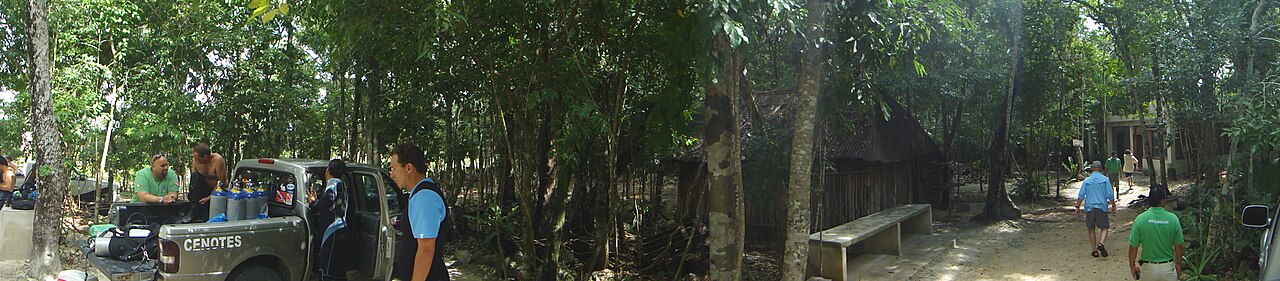
The shaft of light dropping through the circular opening around midday, and the five-minute jungle trail in from the road
Good to know
SafetyShallow water blackout and LMC are the leading causes of freediving deaths. Never dive alone: work one diver down at a time with a buddy or safety diver, and hold face-to-face surface supervision for at least 30 seconds after every dive. Do not hyperventilate.
SafetyBelow the cloud there is almost no light, and depth and orientation cues disappear fast. Always clip a lanyard to the line, and choose an operator that rigs counterballast for deep sessions. Descending past the cloud without a line is not an acceptable risk under any circumstances.
SafetyHydrogen sulfide is a toxic gas. Dissolved in water you will not inhale it while diving, but inside the layer visibility vanishes, and eye and skin irritation plus a strong lingering smell are normal. Minimise time in the layer and ascend on the line. If you are not comfortably managing 25–30 m, the cloud is not a dive you should be attempting.
SafetyFresh water is less buoyant than the sea, so reweight before the session and expect the late part of the ascent to work you harder than it would in the ocean. Recompression chambers are in Playa del Carmen, Cancún and Cozumel, and the cenote sits back in the jungle, so evacuation takes time — confirm that your operator carries oxygen and has a written emergency plan.
RulesCenotes are private property and in-water activity is run with a registered local guide or instructor. Entry fees are charged separately for diving and swimming, and quoted amounts vary widely between sources, so treat any figure as unconfirmed. Many schools require documented experience or certification to around 30 m plus proof of insurance — check your policy, since standard travel cover frequently excludes freediving or caps depth.
MannersSunscreen and insect repellent must be washed off before entry and a shower is usually mandatory. Touching or breaking formations or the submerged timber is treated as a federal offence. Cenotes are sacred in Maya culture, so keep noise down and carry everything out.
CautionEntry and tour prices differ sharply between sources and seasons, and some gates take cash only. Avoid informal guides soliciting at the roadside, and get written confirmation of what your booking covers: entry fee, divers per guide, and which safety gear (line, lanyard, oxygen) is supplied.
Practical info
Fly into Cancún (CUN) or Tulum (TQO), then drive south from Tulum on Highway 307 for about 15–20 minutes; from Korea the usual routings are Aeroméxico's Incheon–Mexico City service with a domestic connection, or a US transit, and Korean passport holders enter visa-free for tourism (Mexico's SAE electronic authorisation does not apply to Korean nationals). Water temperature and visibility are stable all year, but the June–November rainy and hurricane season can disrupt access roads and schedules, so November–April is the safer window; freediving is booked through schools only, so confirm entry fees, opening hours, experience requirements and insurance conditions directly with the operator and the cenote before you commit.
On-site reviews📍 Verified on-site
No reviews yet. If you are here, be the first to leave one.